Sunday, July 30, 2023

Fwd: Experimentation Drives Success


---------- Forwarded message ---------
From: Peter Diamandis <peter@diamandis.com>
Date: Sun, Jul 30, 2023 at 11:10 AM
Subject: Experimentation Drives Success
To: <stevescott@techacq.com>


The Tech Blog

by Peter H. Diamandis, MD

Presented by

Experimentation Drives Success


Building a culture of Experimentation in your startup is probably one of THE MOST important things you can do.


As Amazon founder Jeff Bezos once said, "Our success at Amazon is a function of the number of experiments we run per year, per month, per day."


Experimentation is the means by which Exponential Organizations (ExOs) make data-driven decisions. Each experiment creates a set of learnings that can be used to improve a product, service, and/or process, or test a new product or service. 


In today's blog, I'll share key insights and lessons from Amazon and other successful companies and offer tips on how to build a culture of experimentation in your own company. 


Let's dive in…


NOTE: Understanding how to turn your business into an ExO and increase your growth and impact is a key component of my year-round Abundance360 leadership program. 


Amazon & Experimentation


My friend Jeff Holden is a renowned innovator and past XPRIZE board member. His illustrious career is marked by key roles at Amazon, Uber, and his current venture, Atomic Machines.


As Chief Product Officer at both Amazon and Uber, he spearheaded the creation of Amazon Prime and popular Uber services like Uber Eats and Uber Pool (now UberX Share).


He has a wealth of experience in disruptive innovations, which he distilled down to four key lessons when I sought his advice on an early podcast.


Jeff's first directive is to design your company as a potent experimental engine from the beginning. In an era where change is the only constant, continuous innovation and Experimentation are crucial for survival and hyper-growth. Jeff incorporated this ideology at Amazon, Groupon, and Uber.


Integrating this experimental engine isn't an effortless task, and it often requires a cultural transformation in established companies. It also requires a commitment to ceaselessly test bold ideas, new business models, products, and processes. This principle was evident in Amazon's early days when a comprehensive experimental platform was made available to almost everyone.


This openness led to an onslaught of experiments, many of which proved futile. As Jeff explains, Amazon ran countless experiments out of sheer curiosity, despite their costs and inefficiencies. Eventually, Amazon formed an Experiments Group. Before executing an experiment, its hypothesis and potential value to the company had to be convincingly presented.


Proper interpretation of experimental results is Jeff's second key lesson. Like Uber, which runs thousands of monthly experiments and bases decisions on statistical significance, knowing the difference between significant and insignificant results is crucial. At Uber, only about 20 to 30% of experiments are successful, but all provide valuable insights. Jeff's advice? Ignore the external noise, stay focused, and continue to build.


In his third directive, Jeff provides two key pointers about constructing a team and a company:

  • Nurture an experimental ethos within the organization and;
  • Hire individuals familiar with Experimentation and a data-informed mindset.

Finally, Jeff emphasizes the importance of comfort with being misunderstood in his fourth directive. Strong experimental cultures often invite misunderstanding from external observers.


Jeff cites Amazon Prime, which was initially met with skepticism but now has over 50 million members, as an example: "Amazon Prime could have been one of those catastrophic failures," says Jeff. "We tried auctions, and that failed, and we tried zShops and that failed. But we just kept going, and we finally cracked it. Then, when we launched it to the world, the response was: 'You guys are insane! This is like, super risky. You're going to blow up with all this margin from shipping.' Bezos, characteristically, replied, 'Yeah, I kind of figured this would be misunderstood.'"


Key Lessons


As Salim Ismail, my co-author of Exponential Organizations 2.0, and I reflected on Jeff's directives as well as our own experience, we arrived at several observations and conclusions about the role of experimentation in business.


In this section, I'll share a summary of these key lessons.


Lesson #1: A to B, then to C


A key insight from the Lean Startup movement is that if you are at point A, you cannot see point C, so focus on getting from A to B.


Once you're at B, then you can see point C and plot a course toward it. For example, if you're building a product with 15 features, don't build them all. Build the two that will get you market traction and feedback from users, then plan the implementation of the rest. This is also known as the MVP or Minimum Viable Product. Experimentation serves as the tool of choice when organizations have a clear destination in mind but lack a predefined roadmap to reach it.


By embracing Experimentation, companies open themselves up to agile and iterative processes that enable them to navigate uncertainty and adapt to changing circumstances.


Lesson #2: Imagination and Experimentation, not Expertise and Experience


A prevailing myth that must be debunked is that an expert holds the key to guaranteed success. As I often say, "The expert is someone who can tell you exactly how something will not work."


An ExO acknowledges that expertise alone is not sufficient and that relentless Experimentation is essential for progress. By shifting the focus from seeking expert opinions to creating a culture of learning and experimentation, organizations can tap into the collective intelligence of their teams and communities to explore new frontiers.


Salim and I interviewed Sebastian Thrun of Udacity about this topic. Sebastian said, "When hiring, I look for imagination, not experience."


Lesson #3: Secrecy


Unless Experimentation is the default policy throughout an organization, secrecy is critical when conducting experiments.


Smart organizations often operate in stealth mode to protect against larger market consequences and media exposure when shutting down unsuccessful projects. This freedom to fail in private allows them to experiment more boldly, explore unconventional ideas, and iterate without fear of external judgment.


Lesson #4: A Culture of Learning


An ExO is the embodiment of a "learning organization."


Creating a culture that encourages taking risks is vital for unleashing the full potential of Experimentation within an organization. By instilling a sense of psychological safety and removing the fear of failure, teams become more inclined to explore uncharted territories.


The best ExOs go beyond mere lip service and establish reward mechanisms, including the use of crypto rewards, to incentivize and recognize successful experiments conducted within the community. Top ExOs give awards and recognition to team members who take big operational risks, fail, and then share their learnings.


Lesson #5: Big Companies Can Also Experiment


Large, mature organizations often face challenges when it comes to adopting a culture of Experimentation: namely higher costs, regulatory barriers, and a fear of failure.


Double that for government departments. However, some multinational corporations have recognized the value of running experiments in smaller markets to mitigate these challenges and test ideas more efficiently. This approach allows them to reduce costs, gather valuable insights, and make informed decisions before scaling globally.


Lesson #6: Living on the Edge


While the above heading sounds dangerous, it's actually the opposite. By constantly experimenting, organizations stay closer to market realities.


This is especially important in volatile and uncertain times. Their constant learning delivers an agility that enables them to remain responsive to market shifts and customer demands. By embracing Experimentation as a core attribute, ExOs ensure that they are constantly learning and evolving, positioning themselves as frontrunners in their industries.


How to Build a Culture of Experimentation


So, how can you create a culture of experimentation in your business?


If you're a startup, it's relatively trivial to implement an experimental culture. This task, however, becomes much more difficult as organizations get bigger. Large organizations are geared toward efficiency and predictability, which are antithetical to experiments that are counter to both those objectives.


Here are some steps to integrate this Experimentation into an organization:

  • Appoint a "head of experiments" to educate the team on the qualities of a good experiment and, in turn, prompt continuous Experimentation.
  • Award those teams that run experiments and learn, whether they succeed or fail.
  • Elevate the Experimentation conversation to your weekly or monthly executive staff meeting. Have your teams report on the experiments they ran and what they learned. Again, reward the effort, but don't penalize the failures.
  • Encourage your management team to ask great questions. This is an analog of the MTP. ExOs think big in almost everything they do—and never more so when experimenting with new products, markets, technologies, organizations, customer experiences, and employee culture. Formulating great questions is an art form. It also takes courage. But somewhere out there is that one question that can lead to a billion-dollar opportunity for your company.
  • Utilize generative AI as a thought partner to recommend experiments you should be running, how to design them, and what parameters to measure.
  • Run an incentive prize (or series of prizes) in your company to canvas crazy ideas. As described in my book BOLD, MIT's Michael Schrage said, "The best way to become innovative is to innovate more." Schrage suggests running a 5x5x5 design competition within companies to encourage such innovation. Here's how that works: 
    • Step 1: Within your company or group, organize a minimum of 5 teams of 5 people each. The teams should have a diverse makeup of executives, engineers, marketing members, executive assistants, customers, and suppliers.
    • Step 2: Give each team a period of 5 days to come up with a portfolio of 5 "business experiments" that should take no longer than 5 weeks to run and cost no more than $5,000 to conduct. Each experiment should have a business case that explains how running that experiment will give tremendous insight into a possible savings or growth of $5 million for the firm. Tell the teams that you're not looking for incremental improvement but significant changes that are exponential in nature.
    • Step 3: Run the 5-week experiments and have each team report on their outcome. If one or two of the experiments yields significant results, invest in those ideas to develop new products or services.


Why This Matters


In today's dynamic business landscape, adaptability and innovation are crucial.


Experimentation is a tool of transformative potential. It goes beyond mere testing and trial and error—it's about cultivating a mindset of discovery, driving innovation, enhancing performance, and embracing the unknown.


As I often say, "The day before a major breakthrough, it's a crazy idea."


If you're not experimenting, then you're an incremental organization and not an ExO.


A successful culture of Experimentation requires a strong element of Autonomy, the next ExO attribute and the topic of our next blog in this series.

Want to learn about how to increase your healthspan? And the top longevity-related investment opportunities available?


If yes, then consider joining me on my 2023 Abundance Platinum Longevity Trip.


I'm running two VIP trips I call my "Abundance Platinum Longevity Trip" covering top scientists, startups, labs, and CEOs in Cambridge, Boston, New Hampshire, and New York. I do the same trip twice for up to 40 participants: Aug. 16 - 20, 2023 or Sept. 27 - Oct. 1, 2023.


The September Trip is SOLD OUT.


The August Trip (Aug. 16 - 20, 2023) has limited seats available.


Each trip is a 5-Star/5-Day deep dive into the cutting-edge world of biotech/longevity and age-reversal.


You'll meet with the top 50 scientists, CEOs, and labs working on adding decades to your life. You will also learn about breakthroughs against a wide range of chronic diseases.


This year, some of the world-changing labs and faculty we'll visit include: David Sinclair, PhD, Harvard Center for Biology of Aging Research; George Church, PhD, Harvard Wyss Institute; Dean Kamen, PhD, Advanced Regenerative Manufacturing Institute (ARMI); and Fountain Life, New York—just to name a few.


Both trips are identical (capped at 40 participants per trip), during which I spend all 5 days with you as your private guide and provocateur. Through this personalized, action-packed program, my mission is to give you exclusive, first-hand exposure to the major players, scientists, companies, and treatments in the longevity and vitality arena.


Here's what you get: All your questions answered. First-hand insights and early access to diagnostics, therapeutics, and investment opportunities.


If you want to learn more about the Abundance Platinum Longevity Trip, go here, indicate your interest and we'll set up an interview!

I discuss topics just like this on my podcast. Here's a conversation I recently enjoyed:

A Statement From Peter: 

My goal with this newsletter is to inspire leaders to play BIG. If that's you, thank you for being here. If you know someone who can use this, please share it. Together, we can uplift humanity.

PHD Ventures, 800 Corporate Pointe, Suite 350, Culver City, California 90230, United States, (401) 542-2360

Unsubscribe Manage preferences

Thursday, June 15, 2023

Timothy Kenny via s1.csa1.acemsd3.com 3:11 PM (2 hours ago) to Stevescott Welcome back to my newsletter. I revealed my favorite ChatGPT Chrome extension here -- which helps me better integrate ChatGPT into my lifelong-learning processes. The creator of this extension also writes and AI newsletter, which is worth checking out. Feel free to reply to this email with any ideas for ChatGPT related videos you’d like me to create. New ‘Documentary’ on the Autodidacticism of Malcolm X. I was amazed learned about the depth of Malcolm's reading while in prison, up to 15 hours a day, which covered subjects like: Great Books of the Western World and the Harvard Classics Series Learning Latin and German and studying etymology Reading the dictionary and encyclopedia cover to cover How he joined the prison debate team -- that went on to beat Ivy League visiting teams Smuggling legal treatises and textbooks into prison for him to read The comments have been very lively. Part 2 of this 2 part series will be coming soon. Backstory: Malcolm X was the (arguably) largest influence on President Obama’s self-education during his younger years. To quote from Obama’s first book: "I gathered up books from the library- Baldwin, Ellison, Hughes, Wright, DuBois. At night I would close the door to my room, telling my grandparents I had homework to do, and there I would sit and wrestle with words, locked in suddenly desperate argument, trying to reconcile the world as I’d found it with the terms of my birth. But there was no escape to be had. In every page of every book, in Bigger Thomas and invisible men, I kept finding the same anguish, the same doubt; a self-contempt that neither irony nor intellect seemed able to deflect. Even DuBois’s learning and Baldwin’s love and Langston’s humor eventually succumbed to its corrosive force, each man finally forced to doubt art’s redemptive power, each man finally forced to withdraw, one to Africa, one to Europe, one deeper into the bowels of Harlem, but all of them in the same weary flight, all of them exhausted, bitter men, the devil at their heels. Only Malcolm X’s autobiography seemed to offer something different. His repeated acts of self-creation spoke to me; the blunt poetry of his words, his unadorned insistence on respect, promised a new and uncompromising order, martial in its discipline, forged through sheer force of will." You can see my videos on Obama’s education here: Intro, Episode 1, featured in a previous newsletter, here. (NEW) President Obama’s Mother Ann Dunham's Education (Episode 2 of Barack Obama: Renaissance Man) (NEW) President Obama’s Father Barack Obama Sr.'s Education (Episode 3 of Barack Obama: Renaissance Man) You can also watch my new presidential series interviews below, which focus especially on the education and formative years of former presidents. Jonathan Alter - The Presidents Compared - FDR, Bushes, Clintons, Obama, Trump, Biden and More This 3h interview is the longest and most in depth interview Jonathan has ever done. He’s personally interviewed 9 of the last 10 presidents and is a 3x NYT bestselling author for his books on the presidency. This is our 2nd interview, the first was a month prior, which you can watch here, on President Carter. Watch my new interview with 2x Harvard (BA, MBA) and 1x Johns Hopkins (MD-in-progress) Cofounder and CEO of Osmosis Shiv Gaglani -- Osmosis is one of the major education companies that med students and nursing students, among others, use. They were recently acquired by Elsevier, the biggest of the Big 5 in academic publishing (Elsevier, Black & Wiley, Taylor & Francis, Springer Nature and SAGE) You may also be interested in my recent 2h interview with Benjamin Keep, a Youtuber and Stanford PhD in Learning Science who advises startups on best practices (as well as tips for students) here: Benjamin Keep Interview: Learning Science Expert (Stanford PhD in Learning Science, Cornell JD) We discuss: His interest in East Asian studies including the classics of China, Japan and Korea His minimalist approach to his Tech (hardware and software) Stack His current Learning Project about learning Ancient Chinese history What he’s learned playing Chess, Go, Poker, Starcraft and Magic the Gathering And much more that you won’t find anywhere else. If you’re new to my newsletter, here’s some of my most popular videos: Recent video - Don't Fall for These 39 Neuromyths that Many Learning Experts Still Teach (Evidence-Based) This is the newest addition to the "Accelerated Learning Canon" Playlist. Check out the 10 videos below, which cover the most popular and influential books, articles, papers, videos and apps in the accelerated learning space. I’ll be updating the playlist in the future as well. If you have any suggestions, please reply directly to this email. Surrender to This Algorithm - Gary Wolf - Wired Magazine 20 Rules of Formulating Knowledge - Piotr Wozniak Deep Work - Cal Newport Spaced Repetition for Effective Learning - Gwern Branwen (most popular this week) The Janki Method - Jack Kinsella The MIT Challenge - Scott H. Young Mental Models - Farnam Street and Shane Parrish Evidence-Based Accelerated Learning - Ali Abdaal See my discussion with Danny Hatcher in the comments Augmenting Long term Memory - Michael Nielsen Lots of content in this 45m in-depth video Image Occlusion, Heatmap, Cloze Overlapper - Glutanimate - Anki Dev Timothy P.S. You can check out all my previous interviews with prominent experts in the productivity and learning space, and top people in the great books and the classics, in this Youtube Playlist. You may also like my playlist on The Education of Billionaires, Geniuses and Royalty. P.P.S. I’m doing a special deal if you buy my friend Scott H. Young’s Rapid Learning program during the current enrollment period (end Midnight PT Friday Night in about 33h). If you get any level of the 3 tiers of the course, just send me your receipt and I’ll send you a $100 gift card usable on any of my future premium courses (usable once the refund window closes on Scott’s course). [BTW, you can watch my 3h interview with Scott (the longest he’s ever done) here.]

Thursday, March 16, 2023

Liquidity Crises and Fiduciary Duties of Directors of Early-Stage Companies


Liquidity Crises and Fiduciary Duties of Directors of Early-Stage Companies
READ MORE

The FDIC receiverships of Silicon Valley Bank and Signature Bank have caused certain early-stage companies to face potentially crippling near-term liquidity issues. These liquidity issues may result in a company becoming insolvent. Therefore, boards of directors of such companies need to consider their fiduciary duties as well as steps that can be taken to mitigate risks.


Fiduciary duties are typically owed to the company for the benefit of its owners.

While each state has its own interpretation of fiduciary duties, the general rule is that a corporation owes fiduciary duties to the corporation and its owners. That rule changes, however, when a company is insolvent. During insolvency, the board owes its duties to the corporation and its creditors. Note that Delaware law no longer holds that fiduciary duties begin to shift from equity holders to creditors when a company is approaching the so-called “zone of insolvency,” and duties continue to be owed to the enterprise as a whole.


There is no single definition of insolvency.

Courts historically use a number of “tests” to determine when a company is insolvent. These determinations of insolvency include reviewing whether: (i) the value of a company’s liabilities exceeds the value of its assets (the “balance sheet test”), or (ii) a company’s cash flow is no longer sufficient to pay obligations as they become due in the ordinary course of business (the “equitable insolvency test”). Moreover, insolvency can occur gradually or all at once—including because of a liquidity shortfall due to the loss of a financing or banking relationship. In the current environment, if a company knows (or should know) that it will not be able to pay its obligations, either due to the loss of a banking relationship or otherwise, it may have reached the point of insolvency.


In practice, it is challenging to determine when insolvency occurs, especially for early-stage companies without recurring sources of revenue. Forecasting cash inflows and outflows is key, and a company should be conservative in its cash planning. It may be necessary for companies to seek emergency funding from their current investors or outside sources. A board should seek the advice of its trusted advisors to help determine how much “runway” a company has and whether additional capital is available to avoid insolvency.


Fiduciary duties include the duty of care and duty of loyalty.

The actions of directors—and the fiduciary duties that underlie them—are governed by the law of the state in which a company is organized or formed. These duties typically include the duty of care and the duty of loyalty, and they require a board to act in good faith and in the best interests of the corporation and its stakeholders (be they shareholders or creditors).


The duty of care requires a board to stay informed and make decisions with the “requisite care.”

To meet the duty of care, a board should examine all material information about the business that is reasonably available and, in making decisions, consider all relevant information and reasonable alternatives. This may even permit a board to approve “long-shot” or “Hail Mary” transactions so long as the decisions are well-informed and the risks of success are properly weighed against the likelihood of failure.


In practice, and especially when insolvency is a consideration, a board should consult with its legal and financial advisors to ensure that it is taking all necessary actions to protect the business. In discharging the duty of care, directors may reasonably rely on the advice of advisors whom the directors reasonably believe are acting in areas of their professional expertise and who have been selected with reasonable care.


During a liquidity shortfall, it is particularly important that directors and officers preserve cash to pay employee wages and benefits as well as employment-related taxes; otherwise, directors and officers may face personal liability if they continue to allow employees to work beyond the point in time at which they know the corporation does not have sufficient funds to pay employee wages, benefits, and related tax liabilities. Boards should also consider whether a state-law WARN Act applies to employee reductions in force or layoffs.


A board may also consider appointing a “liquidity management” committee to focus on these issues specifically.


The duty of loyalty requires a board to balance the interests of various groups.

Directors must act in good faith and in a manner they reasonably believe to be in the best interests of the enterprise. Taking action will require understanding the conflicts that exist or may exist between various stakeholders.


It is of particular importance for employees of venture capital funds who sit on boards of portfolio companies to recuse themselves from decisions that create the impression of a conflict between the interests of the corporation and the interests of the venture capital fund. For example, if a venture capital fund is seeking to provide the company with “rescue financing,” board members associated with the fund or sponsor should not be part of the decision-making process and the company should consider all reasonably accessible potential sources of capital before agreeing to funding from existing sources.


If a board member/venture capital employee is involved in a “dual fiduciary” decision, and that decision is later challenged, courts will look to the “entire fairness” of the transaction. That is, courts will take a closer look at whether the transaction was the product of both fair dealing and fair pricing. It is of the utmost importance that a board and venture capital fund obtain proper counsel before entering into a transaction that could later be challenged as “self-dealing.”


The actions of a board and management team are protected—to a degree.

In most circumstances, assuming the above-mentioned rules are followed, a board’s decision-making will be protected. However, if a board’s decision-making is subsequently challenged, a court will typically avoid “second-guessing” decisions by deferring to the “business judgment” exercised by directors; this includes any judgment made by relying on the advice of legal or financial advisors.


However, certain actions will remove this protection from a board’s decisions. Obvious pitfalls include engaging in self-dealing or insider transactions, committing fraud, and failing to fulfill certain corporate responsibilities. In addition, directors may be liable for the unlawful payment of dividends or unlawful stock repurchases when the corporation is undercapitalized. A board must discuss these pitfalls with its trusted advisors before taking any such actions.


Practical measures for limiting director liability in the face of a liquidity crisis.

While there is no way to prevent a disgruntled shareholder or creditor from filing suit, boards can protect themselves by considering the following actions in consultation with discussions with their advisors:

  •  Maintain an appropriate amount and type of D&O insurance, even if liquidity is tight. In addition, a board may want to consult a specialized “restructuring” insurer who can review existing policies and suggest changes to the policies to maximize protection.
  • Ensure that corporate records reflect a sufficiently deliberative process and the board’s awareness of its fiduciary duties.
  • Thoroughly review actions that may prefer one constituency over another constituency.
  • Document the scope of fundraising efforts and alternatives to financings (such as a merger, asset sale, or reduction of operations to conserve cash).
  • Exercise care in approving transactions that leave a corporation inadequately capitalized, even if the corporation is solvent at the time.
  • Disclose any potential conflicts of interest and scrutinize all insider transactions.
  • Confirm that all tax obligations (such as franchise taxes, sales and use taxes, and withholding obligations) are satisfied or that funds have been set aside to satisfy the obligations.
  • Do not require employees to come to work if it is clear, or should be clear, that the company does not have sufficient funds to pay employees.
  • If the decision is made to wind-down the company or prepare a bankruptcy filing, create a realistic budget that allows for an orderly process rather than a fire sale.

Read our client alert.
author photo
SETH J. KLEINMAN
Partner
skleinman@mofo.com
author photo
JENNIFER L. MARINES
Partner
jmarines@mofo.com
author photo
LORENZO MARINUZZI
Partner
lmarinuzzi@mofo.com

Thursday, March 9, 2023

How to Make Money as a Ghostwriter: Insider Tips to Get Started


How to Make Money as a Ghostwriter:
Insider Tips to Get Started

By Robert Rice

Two copywriters discussing a project on an iPad

Ready to learn how to become a ghostwriter — and how to make money writing in the process?

Whether you're an experienced freelance writer or you're just breaking into the industry, ghostwriting can be a lucrative and rewarding way to build your writing business.

There's just one thing:

Ghostwriting isn't for everyone, and there are important factors to consider before writing for someone else (without receiving credit).

In this article, we'll answer your top ghostwriting questions like:

  • What does a ghostwriter do?
  • How can I become a ghostwriter?
  • How much do ghostwriters make?

Then, we'll take you behind-the-scenes in an interview with professional ghostwriter Tim O'Leary, so you get insider advice on what it's really like to make a living as a ghostwriter.

Read on to learn how to become a ghostwriter and discover if it's the right path for you.

What Does a Ghostwriter Do?

What is ghostwriting — and how is it different from other kinds of freelance writing projects?

ghostwriter is anyone who writes for someone else without receiving credit for their work. Ghostwriters might pen content for projects like blog articles, emails, speeches, memoirs, or novels.

Wondering why anyone would want to pour their talent and energy into a writing project they know they won't receive credit for?

The answer is simple. There is a thriving market for ghostwriting services, and it's one of the most readily available ways to make money writing.

If writing is your passion, why not make it your day job, too?

"If I had known ghostwriting was a career option, I would've jumped in right after college instead of spending time in offices where I felt creatively stifled."
– Tim O'Leary, professional ghostwriter

People in all niches and industries want to write but lack the time, motivation, or know-how to do so. Whether it's for a personal passion project or a defined business goal — professional ghostwriters help people tell their stories.

Anyone with an idea for content might hire a ghostwriter to help them turn their vision into a reality. Maybe it's a celebrity or an athlete ready to publish a memoir. Or perhaps it's a business owner who wants to share their knowledge and build their authority through blog posts.

Even some of the biggest names in publishing, like James Patterson outsource parts of their writing process.

As a ghostwriter, you get to do what you love (writing), and your client achieves their content goals. Plus, you can generally charge more for your writing services because you're not receiving credit for your work.

There are other pros to becoming a ghostwriter, too. Generally speaking, your clients will provide you with the information or research you need for the project since they're the ones with a story, idea, or expertise to share.

Most ghostwriters aren't responsible for promoting or marketing the finished product, either.

If you want to spend more time putting pen to paper while helping people bring their stories to life, then ghostwriting could be the perfect option for you.

In contrast, here you can learn what is freelance copywriting and how it is different from ghostwriting.

How Much Do Ghostwriters Make?

Many writers ask how to become a ghostwriter so they can charge more for their work. So, just how much do ghostwriters make?

Well, it depends. Experienced freelance writers can demand more for their skillset; books and memoirs pay more than blog posts or short-form copy.

On average, a ghostwriter can make between $10,000–$50,000+ for a nonfiction book or memoir. For blog posts or articles, ghostwriters can easily earn between $150–$500+. Rates vary based on word count, the writer's ability, the client's goals, and budget.

Let's say you charge $20,000 for a 60,000-word book. If it takes you four months to complete a project, you could earn $60,000 a year from ghostwriting. Add to the mix other writing projects like blog posts and website copy, and you can easily make six-figures as a ghostwriter.

How Hard Is It to Become a Ghostwriter?

If you're intrigued by the idea of becoming a ghostwriter, I've got good news:

Breaking into the business of ghostwriting might be easier than you think!

There are countless people with stories to tell — individuals with a mission and the budget to outsource their writing projects. The secret is to connect with your ideal client, then turn their great idea into a written masterpiece.

Becoming a ghostwriter doesn't happen overnight. But with the right tips, you can become a highly paid ghostwriter, too.

Follow these steps to start attracting ghostwriting clients and projects:

1. Build Your Freelance Writing Portfolio

One of the most common questions about how to become a ghostwriter is:

How can I build my portfolio if I can't take credit for my writing?

Since you can't market your ghostwriting projects as your own, it's helpful to have a few freelance writing samples under your belt.

So, write a short story or a couple of articles. They don't have to be exceptionally long, but they should represent your best work so you can showcase your writing talent and build your credibility.

2. Get Comfortable Writing in Different Voices and Styles

The best writers often have a clear, recognizable style. But when you're learning how to be a ghostwriter, adaptability is an essential skill to develop.

As a ghostwriter, your pen is a vehicle for your client's voice, not your own. Train your brain to use the words, rhythm, and energy that match your client — to be a writing chameleon, so to speak.

3. Nurture Your Relationships and Network

What's the next step in how to become a ghostwriter? Seek out ghostwriting opportunities!

Be proactive and build your personal network. Don't be afraid to ask people in your life if they need a ghostwriter — you never know who has a story to tell.

Here are a few easy ways to market yourself as a ghostwriter:

  • Update your social media bios
  • Guest post about ghostwriting
  • Leverage your existing clients
  • Apply to work with firms
  • Search on writing job forums

As your ghostwriting client base grows, so too will your referrals and opportunities.

How to Be a Ghostwriter: An Interview with Professional Ghostwriter Tim O'Leary

Tim O'Leary is one of many writers working "behind-the-scenes" to help people transform their story ideas into reality.

His only regret? Not diving into ghostwriting sooner.

In a recent interview, I asked Tim how he got his start in ghostwriting, how the work has shaped his life, and his advice for "up-and-comers" who want to break into the business.

Learn what Tim had to say about how to become a ghostwriter.

What were you doing before you started ghostwriting?

I was working sales at a high-end gym in the West Village of New York City to support my playwriting career. It was 60 hours a week minimum with hardly any time off, since gyms never close, and the burnout rate was incredibly high. I saw many, many people come in and out during my time there.

But, I stayed because the money was good and I was actually halfway decent at selling. Who knew?

How did you get your start as a ghostwriter?

A good friend of mine who was working for a ghostwriting firm reached out to me because they were in desperate need of writers. Talk about a sentence I never thought I would hear …

Writing is my first passion, and I was ready to leave my sales job, so I took the opportunity to send them a few samples of my work.

Thankfully, they liked my materials enough to give me a chance as a baby writer.

Can you elaborate a bit on your writing experience and what samples you sent?

I was pursuing a career as a playwright, so I had done a lot of writing for myself — plays, short stories, and even a novel that was never published. Professionally, I wrote movie and theater reviews for two websites, as well as advice and dating columns.

I submitted a few columns I wrote, as well as a chapter from my book. Honestly, any writing you have lying around can work as a sample. It just has to show your style.

What does being a "baby writer" entail?

Essentially it's like an entry-level position. They matched me with a client who had a smaller budget and I wrote a full-length novel for him. The experience was incredible, as I learned how to execute someone else's vision. It was my first time doing that.

Thankfully, he made the job simple by being easy to work with and very clear on what he wanted.

How did things change after that first novel?

The client was so pleased with the work that the next book they gave me was a significantly higher payout. And before I was one-third of the way through that book, I got another offer for something even higher.

At first, I was worried about juggling multiple projects at once, but I found it was quite doable with a bit of planning.

For readers wondering how to become a ghostwriter, what does a typical ghostwriting project look like?

Projects vary quite a bit, but the first thing we always do is have a phone conversation to discuss what they're looking for. Sometimes they have an outline, sometimes it's just two sentences of an idea. It's my job to take whatever they have and help shape that into a story.

After that, I create an outline of every chapter, so we have a clear roadmap of how the book goes and writing goals. Once the client approves, I get to work writing the pages.

I'll send anywhere from 5 to 15 pages at a time. If the client has notes, I'll make those revisions, and once they approve what I've written, it's locked. This makes it so we don't endlessly go back and forth.

How long does a book take you to write?

Typically a novel-length book takes anywhere from six months to a year and a half. That's why the pay is high — it's a long-term commitment.

Since you mentioned it, how does ghostwriting pay?

It's easy to make money as a ghostwriter. If you're self-employed, you can start around $10,000 per project and build all the way up to $50,000 or more. I'd say new writers can expect $10,000-$20,000 on a first book (assuming the client is respectful) and then after that, $30,000 and up is totally normal. If you decide to work through a firm, you will make less but you'll be given clients. Either way, you get to work from home, which is the best payment and one of the top benefits of being a writer.

What's your day-to-day life like?

A typical day in my writer's life is waking up around 9 a.m. (I'm a night owl), having breakfast, and then getting to writing. I write well early and late, so I use those times to get pages done. In between, I deal with emails and phone calls.

I am also pursuing television writing here in Los Angeles, so I use my free time to write scripts, produce series, and apply for studio fellowships. Thankfully, ghostwriting allows me to keep my own schedule, so I work whenever I want, wherever I happen to be!

Recently, I was hired as a co-writer (which is basically ghostwriting with credit!) for a book series.

Do you only work on books as a ghostwriter?

Novels, memoirs, and screenplays are my specialties. However, my firm offers services for any type of writing you can think of.

Clients hire us for editing and even consulting on projects they want to write themselves. Basically, if you have a gem of an idea, we can take you from outline to finished novel, to signing with an agent, to potentially a brokered deal with a publishing house. It's amazing!

As a side note, consulting is fun and quite lucrative if you enjoy developing stories but don't want to write a whole book for someone.

What are your favorite genres to write?

I particularly enjoy action, sci-fi, thrillers. I'm also attracted to stories with unconventional lead characters.

Aside from the money and time freedom, what draws you to ghostwriting?

Honestly, it's a thrill for me to help other people see the stories they've been thinking about for so long become a reality. So many people dream of writing books but never make the time to get around to doing it. I give them the gift of checking that item off their bucket list.

It's also great to finally say, "I write for a living." It's the coolest feeling in the world and I constantly feel inspired by the projects I get to work on.

How can someone learn how to become a ghostwriter if they're just starting out?

The best thing to do first is to get a few samples together. Write a short story, or an article or two, showcasing your style and your writing expertise. They don't have to be particularly long.

Once you have a sample, you can start seeking work. You can either apply to work with firms or find work on writing sites. Or, you can get creative and ask people in your life directly if they want to write a book. You'd be amazed how well that works.

I landed a $30,000 project independent of my firm because a veteran friend of mine wanted to write a memoir. Another friend of mine who heads the psychology department for a university was ready to pay $10,000 for a novel.

Ready to Start Ghostwriting?

At the end of the day, it comes down to building relationships and referrals. So many people are ready to have their stories told, and you could be paid handsomely to tell them!

So why not consider ghostwriting as a way to kick off your writer's life? You'll be well paid and get to do what you like most: write.

For the first-time ever, AWAI has launched a self-paced training program titled, How to Become a Sought-After, High-Income Ghostwriter. You'll get the skills and know-how you need to become a respected, well-paid author, directly from successful, best-selling ghostwriter Laura Gale.

Don't miss this ridiculously low introductory price — it goes away at midnight. Check out all the details here!

What's Hot at AWAI …

👉 LAST CHANCE: Grab our BRAND-NEW Ghostwriting program at the amazing low launch price before midnight!

😄 The importance of feedback.

✅ How to become a successful ghostwriter like this CPA has done. #NationalGhostwritingWeek

😍 New Jersey man turns writing sideline into a full-time income.

💰 How writers make lucrative money telling the stories of busy executives, thought leaders, and even celebrities.

How His "Anytime, Anywhere" Writing Career Allows Robert to Pursue His Other Passion Projects …

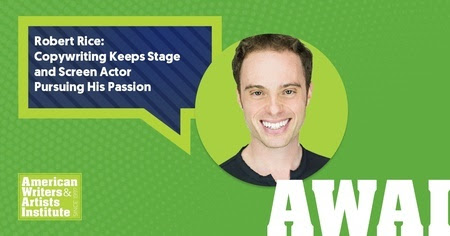
AWAI Case Study graphic about Robert Rice

Robert Rice wanted a reliable income that wouldn't interfere with his passion for acting. Find out here how copywriting offered him exactly what he was searching for … and changed his life in innumerable ways.

Robert just updated us that he and Tim have created a production company in Los Angeles where they develop genre Film and TV projects. It's still under wraps, but this year, they're developing a short-form TV series for a streaming service that Tim is writing and directing.

Congratulations, Robert! Can't wait to hear more when you can share the details. 😉

If you're ready to check out all that ghostwriting has to offer, don't miss your chance to get the details and low launch price here.

Have your own story to share? Email us at mysuccess@awai.com, or post it over in the Facebook group, so we can celebrate your win too!