Sunday, November 22, 2015

Fwd: plugging into your brain


-------- Forwarded Message --------
Subject: plugging into your brain
Date: Sun, 22 Nov 2015 10:04:39 -0800
From: Peter Diamandis <peter@diamandis.com>
Reply-To: peter@diamandis.com
To: STeve <stevescott@techacq.com>


A few weeks ago, I wrote about Ray Kurzweil's wild prediction that in the 2030s, nanobots will connect our brains to the cloud, merging biology with the digital world.

Let's talk about what's happening today.

Over the past few decades, billions of dollars have been poured into three areas of research: neuroprosthetics, brain-computer interfaces and optogenetics.

All three areas of research are already transforming humanity and solving many of the problems that seem to have stumped our natural evolutionary processes.

This blog is about the latest developments in these fields -- from the most exciting applications today to the most game-changing applications of the future.

[ Click to Tweet about this (you can edit before sending): http://ctt.ec/KWYB9 ]

Neuroprosthetics, Brain-Computer Interfaces, and Optogenetics

Your brain is composed of 100 billion cells called neurons.

These cells make you who you are and control everything you do, think and feel.

In combination with your sensory organs (i.e. eyes, ears), these systems shape how you perceive the world.

And sometimes, they can fail.

That's where neuroprosthetics come into the picture.

The term "neuroprosthetics" describes the use of electronic devices to replace the function of impaired nervous systems or sensory organs.

They've been around for a while -- the first cochlear implant was implanted in 1957 to help deaf individuals hear -- and since then, over 350,000 have been implanted around the world, restoring hearing and dramatically improving quality of life for those individuals.

But such a cochlear implant only hints at a very exciting field that researchers call the brain-computer interface, or BCI: the direct communication pathway between the brain (central nervous system, or CNS) and an external computing device.

The vision for BCI involves interfacing the digital world with the CNS for the purpose of augmenting or repairing human cognition.

And how we interface with the CNS is where it becomes interesting.

There are two approaches. The first is physically connecting wires and neurons with microscopic arrays of metallic pins that stick into the brain and electrically stimulate neurons and/or measure the neuron's electric potential when they fire.

The second, and far more interesting, approach is the arena of "optogenetics" – controlling neurons with light. Using this mechanism, a light-sensitive molecule is inserted into the cell surface of a neuron (usually through a virus vector). The light-sensitive molecule can then allow an outside user to trigger or inhibit the neuron's firing by pulsing a specific frequency of light.

The entire BCI and neuroprosthetics field is just at its infancy today.

To get you thinking about the possibilities, here are a few of my favorite applications illustrating what we can do today.

Today's Applications

  1. Seeing: About 70 blind people have undergone the 3-hour surgery for what's called a "retinal implant." As described, "a spectacle-mounted camera captures image data; that data is then processed by a mini-computer carried on a strap and sent to a neuron-stimulating array of 60 electrodes implanted on the retina." While still a long way from completely restoring vision, the notion that we can use cameras to augment or replace lost photoreceptors is promising.
  2. Hearing: As I mentioned earlier, around 350,000 cochlear implants have been implanted in hard-of-hearing individuals over the last 60 years. A microphone picks up sound from the environment, sends it to a speech processor, and then a transmitter converts it into electric impulses. An electrode array sends these impulses to different regions of the auditory nerve, allowing us to bypass the malfunctioning parts of the ear all together.
  3. Feeling Pain: Various companies and research groups (including Stanford University) are exploring how to use optogenetics to "turn off" the perception of chronic pain simply by pressing a bright flashlight to a patient's skin. Pain is the primary reason people see doctors, accounting for $635 billion per year.
  4. Movement/Intention: Fifteen to 20 paralyzed patients have received implants into the motor cortex (the area of the brain that controls movement) that allow them to control external robotic arms or, even more amazingly, reanimate paralyzed limbs by stimulating electrodes implanted in the limb.
  5. Hunger: Like pain, hunger is a sensation. Stanford researchers are exploring how to use optogenetics to curb the sensation of hunger by regulating stimuli from the vagus nerve.
  6. Memory: A researcher out of the University of Southern California is developing a way to restore memory encoding and accessing in people with epilepsy using an implanted computer chip in the hippocampus.
  7. Anxiety: Karl Deisseroth and collaborators at Stanford University "identified a specific circuit in the amygdala, a part of the brain that is central to fear, aggression, and other basic emotions, that appears to regulate anxiety in rodents." With optogenetics, we could soon be able to turn this circuit off…

Where we go in the future is really just mind-blowing.

The Future -- Where Brain Research Is Going

As neuroscientist David Eagleman recently pointed out at TED, our experience of reality is constrained by our biology.

This doesn't have to be the case anymore as we develop new ways to send novel inputs or computational capabilities into the brain.

We could add new senses. (Imagine being able to "plug in" to the stock market, to sense how the market was doing.) We could develop wireless, brain-to-brain communication, something called synthetic telepathy, and send messages to each other by thinking them.

Our brains are a platform and the opportunities for new applications are almost endless.

These applications will challenge what it means to be human. And once we, as Ray Kurzweil predicts, connect our neocortices to the cloud, perhaps we'll become something far more than "human" all together.

Join Me

This is the sort of conversation we explore at my 250-person executive mastermind group called Abundance 360.

The program is highly selective. If you'd like to be considered, apply here.

Share this with your friends, especially if they are interested in any of the areas outlined above.

P.S. Every week I send out a "Tech Blog" like this one. If you want to sign up, go to Diamandis.com and sign up for this and Abundance Insider.

P.P.S. I've just released a podcast with my dear friend Dan Sullivan called Exponential Wisdom. Our conversations focus on the exponential technologies creating abundance, the human-technology collaboration, and entrepreneurship. Head here to listen and subscribe: a360.com/podcast


If you wish to stop receiving our emails or change your subscription options, please Manage Your Subscription
PHD Ventures , 800 Corporate Pointe, Culver City, CA 90230



Avast logo

This email has been checked for viruses by Avast antivirus software.
www.avast.com


Tuesday, November 17, 2015

Fwd: the lil' CHILL PILL for burnt out biz peeps (Part 4)


-------- Forwarded Message --------
Subject: the lil' CHILL PILL for burnt out biz peeps (Part 4)
Date: Tue, 17 Nov 2015 18:05:31 -0500
From: Kevin Nations <kevin@kevinnations.com>
To: Steve Scott <stevescott@techacq.com>


Today we're taking a little bite out of Biz-Burnout...

Kevin Nations swinging in...

You...superstar...

...are about to get part 4 in our little
series on what you DON'T need to
pull in 7 figures a year....and even multiples
of 7 figures every year.

Because we've already talked about 
running your biz with 1-ish lead per day
and ditching the Franken-funnel...(parts 2 & 3)

You may be starting to sense that
financial success without the stress
may be closer on the horizon than 
you may have thought?

Today...

If you're game...

I'd love to bring you a little closer.

If you're feeling "burnt out" or have felt
"burnt out" in the past or seem to catch" "burn out"
faster than kindergarten kids catch the creeping crud...

I can't say what I'm sharing today is 
going to "light" you up.

BUT...

You may find yourself feeling some comfort.

Like a soft glow released after taking a chill pill.

However...

For superstars like yourself...the chill pill usually
tastes bitter at first and the jagged edges stick
to your throat a bit on the way down.

If you can handle that...

Here's the deal...

Much of the consulting I do with clients
is like watching someone run a marathon
with a 100 pound rucksack strapped to
their back.


It's NOT the marathon or their running ability or that
the other runners are better than them that
has them sweating bullets, gasping for air
and exhausted to the point of burn out.

No!

So...

Q: What's burning them out?

A: It's the 100 lb rucksack strapped to
their back!


Now these folks ARE superstars!

Highly, highly, intelligent people.

So why are they running a marathon
with all the "extra baggage"?

Because they are convinced they need
everything that's packed in their rucksack.

What's more...

... is along the way they
pack more and more gear into an already
bulging bag which strains their back to
a breaking point...

In fact...

I just finished up private consulting days
with 3 clients and a majority of what we did was to
pull everything out of the rucksack, go through it and
then I help them determine what could get tossed.

(Hint: A majority can be tossed.)

Then we take the essentials of what's left
and MAP OUT a much more efficient plan.

Like CLOCKWORK without all the baggage
they start "winning" the race of business with
grace and ease.

The NET RESULTS are often in the millions
of dollars in revenue and without the rucksack on
their backs...with so much less strain and stress.

So...

I told you the chill pill might be a bit jagged to 
swallow...

But...I'm shooting it to you straight.

You gotta take an objective look into your rucksack
and ruthlessly toss out what is not essential.


Lighten your load.

Because...When you do...

Because...When you EXPERIENCE how much easier
the race is to win WITHOUT the baggage...

If you're like my other superstars, you'll feel
almost immediate relief and you'll watch
the "other runners" jaws gape open as you sprint
right on by them.

Doesn't it make sense?

Winning is a whole lot easier without
all the weight on your back.

Now...this is important...

If you've got your "rucksack" open right now...

And you're digging and looking for something
you don't need and having a hard time figuring
out what to keep and what to toss...

That's normal.

It's hard to be objective.

And there ARE things we need to be 
strategic about before just "tossing" them.

So....I've got an idea:-)

If it makes sense to you...

Why don't you and I get together
and see if we can lighten your pack and
at the SAME TIME map out MORE revenue for you?

How much more?

It depends, but it's RARE that I can't uncover an
extra six figures or more.

Would that be worthwhile call for you?

If so...

I've set aside some time BEFORE Friday to talk
with you. 

Here's what to do next...

I've got a looooong arse application because
when you fill it out, it will help me to help YOU faster.

Cool?

===>Apply here

Then I'll be in touch to set up your time:-)

Thank You,
Kevin Nations


PS If you missed my last note...I've lovingly 
re-posted it for you below.

*******************************
Death of the Franken-Funnel (Part 3)
*******************************

Have you experienced "funnel anxiety"??

Kevin Nations here...

Good to see ya again:-)

It's good you're here because today is part 3
of what you DON'T need to nail down a consistent
6 figure monthly income for you and yours.

On our last visit together...

We chatted about breaking into the 6
figure a month club as a coach or service
provider with as little as one lead per day.

(If you missed it, you can find it in the P.S. below.)

Today...if you're ready to roll?

Let's start with a question shall we?

Imagine...

If you didn't need 100, 1000 or 10,000 leads
per month - would you really need a complex funnel?... with 
dozens (or more) moving parts?

Hmmmmm...

What if you could just ditch that Franken-funnel??

And you know what I mean by a Franken-funnel right?

It's where you've bolted together 5 different
software programs from Aweber to Lead Pages to Wordpress.

Then when you've get that all held 
together with some driftwood, duct tape and
a bit of bubble gum...

Next...

You code some webinar registration pages
so prospects get added  to your autoresponder and webinar
service at the same time...then you pixel them into
your re-targeting gauntlet...

...(catching a breath)

Then you drop-in the prospects like balls in 
a Pachinko machine and they bounce and
ricochet down through your dynamic follow
up programs....and maybe...just maybe...a lead
or two will make it through this house of horrors?

In my experience, the one or two leads which
may make it through the Franken-funnel are 
rarely IDEAL prospects. 

So...

Partly because I studied nuclear science and
engineering in the Navy...

I could make a compelling case from an engineering
aspect that the more parts you have in ANY
machine, the more TROUBLE and BREAK-DOWNS
you'll have.

And that certainly is true...

Yet...

What I hope you'll consider from
a fresh new angle is: it may just be the Franken-funnel
monster which is EATING ALIVE your BEST, most
affluent prospects...BEFORE they ever get to you.

Now, it would be fool hardy for me to say a funnel
can't be effective for selling certain things. 

A funnel can be a useful tool DEPENDING 
on the job.

Just like a pair of pliers are useful for SOME
jobs, if you use them instead of a socket wrench
to remove bolts, you end up rounding out bolts
and making your future jobs much harder instead of easier.

Franken-funnels are, in my experience, horribly INEFFECTIVE
tools to attract and convert the most affluent and best prospects

Not to mention...

Franken-funnels devour ad budgets faster than
teen-age boys scarf down pizza during a marathon
round of Call of Duty.

Time after time after time...

Nearly THE MOMENT my clients swing the
first wrecking ball to their Franken-funnel...

... their incomes spring to life,

... they find MORE time

...and they discover the joy in their business because
they begin working with real super stars who take
 their advice and see phenomenal results!

Now....

I know folks have a lot of blood, sweat and
tears invested in their funnels.

I get that.

I totally get that.

You might be wondering?

... what do I replace my funnel with if I ditch it?

...do I ditch it all at once?

...is it really a smart move?

Well...

Maybe it is...

Maybe it isn't...

With so much on the line...

Would it make sense to discuss it with me?

If you're open?

I've opened up some time on my calendar this
week to talk with you, so we may explore this together...

I do politely ask that you fill out an application. There's
quite a few questions. Personal ones. I ask that you fill
it out because this helps me, HELP YOU...

===>Apply here

Ya know...

Before I go, I just thought of one other
thing I'd like to point out.

Even when I see folks FINALLY get a Franken-funnel 
constructed and figured out...

They are STILL freaked out.... all the time.

I'd even say they are MORE freaked out.

Why so much "funnel anxiety"??

Because with their whole financial future AND their
families financial future riding on the back of
a funnel with so many moving parts - they fear it's just
a matter of time before one thing goes wrong
and they get bucked off.

The fear is warranted because...

I can NOT tell you how many conversations start out
with..."I waaaaas doing $___________ per month until
_____________happened."


It's a hard....painful...fall.

A fall, I am committed to help saving my clients
from every day.

Simple businesses typically are MUCH more profitable businesses. 

Simple businesses almost always are MORE stable businesses.

Simple businesses are SANE businesses:-)

Would you like to simplify with us?

===>Apply here

Thank You for Listening,
Kevin


PS If you missed Part 2, I've re-posted
it below for your viewing pleasure.

**********************
PART 2: Endless Leads??
**********************

"What I need is mo' leads man!"

Kevin Nations dropping with
part 2 of what you DON'T need to nail
6 figures per month...

In my experience...

Nothing keeps folks from chasing their
tails more than the belief that they need
more and MORE leads.

They come to me absolutely exhausted,
stressed and with gaping holes in their
self-confidence so wide you could drive a tank
through it drunk.

My heart goes out to them.

It's sort of like watching a dog you care
about who won't ever quit chasing their own
tail.

Imagine if you're Dr. Doolittle and could
talk to your dog Spot.

Spot, in between pants and tongue
flailing keeps asking, "How can I catch my tail?"

And for the fifty-eleventh time you try to
explain he can't and never will be able
to catch his own tail...

But he keeps right on...

*Buying books on "tail catching"
*Going through "catch your own tail" courses
*Doing hours of tail wag workouts
*Spot even belongs to 9 Facebook groups of
like-minded dogs trying to catch their own tails

Every night your dog Spot comes home exhausted, grumpy
and feeling like a failure.

Now, I hope you won't mind?

I'm being a bit silly to drive a point
home:-)

But chasing more and more leads 
has almost the same EXACT effect on
people.

Let me be clear...

Do you need "some" leads?

Yup.

But let me ask you?

WHHHHHHYYYYYYYY do you want the 
leads to begin with?

Most people say something like: "I want more
leads so I can make more sales."

And I ask, "What will you have when you have more
sales?"

One way they might answer is, "So I'll have more money."

Aaaah!

"So." it may continue...

"Does more money in the door necessarily
mean more PROFIT?"

"No!"...right?

"So what you REALLY want is more profit
and not more leads?"

And...

I may say something along the lines of...

"Why don't we cut straight to the PROFIT and
do it with far fewer leads? In fact, myself and 
many, many of my clients generate multiple six figures
per MONTH from 1 lead or less per day."

Then we map it out for their business.

Their first reaction usually is...it can't be THIS
EASY!

But after a few weeks of NOT chasing their 
tail...

They find...

*They have so MUCH more time because their
"To Do Lists'" get MUCH SHORTER.

They're not out chasing leads, doing endless podcasts or
interviews, running webinars, dealing with FB
AD shenanigans, watching courses about
Periscope...writing more and more content and on and on.

*Their sales go up immediately. Profits shoot through the
roof because of the "chill" way we bring in the
handful of leads we need WITHOUT giving it
all to the Facebook Ad peeps and at the same
time maximize average customer value.

*Stress levels go way down. 

*They discover nailing 6 figures a month
CAN be way easier than they ever thought.

What about you?

Would you like to see if we can cut out
unnecessary steps to get 6 figures per month for you?

If so...

I've set up some time to talk with you...

I'm going to ask you to please fill out an
application that gets quite personal because
the only way I know to truly serve you is
to get personal with you.

===>Apply here

In my opinion...

The most dangerous thing you could be
thinking right now...

...dangerous to your finances, to your time, to your
energy levels and to your family is...

"Adding 6 figures a month can't be this simple."

And...that again reminds me of our old pal Spot.

Spot actually doesn't have a problem chasing his
tail. Spot is not really as interested in catching his tail
as he is having fun with the chase.

If someone is having fun chasing leads, I'm not
going to stop them:-)

Yet...

If you want to add 6 figures per month
with nearly all of it going straight to the bottom
line and WITHOUT stress and overwhelm...

Then I may be able to help ya...

===>Apply here

Thank You,
Kevin


SilverBack Marketing Corp
6956 E Broad St, # 150
Columbus, OH 43213

Unsubscribe | Change Subscriber Options


Avast logo

This email has been checked for viruses by Avast antivirus software.
www.avast.com


Fwd: Are Masterminds Total BS?


---------- Forwarded message ----------
From: Andrew of Mixergy.com <contact@mixergy.com>
Date: Tue, Nov 17, 2015 at 8:50 AM
Subject: Are Masterminds Total BS?
To: stevescott@leadershippoint.com


Have you read any of those Choose Your Own Adventure books from
the 80s and 90s?

Basically, you become a character in the story. For example, you're
a private investigator, a mountain climber, a race car driver, a spy. 

After a couple of pages, you get two or three choices about what to
do next. Each option leads to more options, and thento one of 40
different endings.

The books were popular because for the first time ever, you got to
control the outcome of a story, instead of just being along for the ride.

It's a lot like starting your own business.

"When you're no longer working in a job where a manager gives you
your tasks for the week, or when you've stopped working on client
projects which have a clear scope and agenda, you get to decide what
to work on every day," writes Brian Casel, on his blog at casjam. "At first,
this is incredibly exciting."

(You may remember Brian from yesterday's email. If not, check your
spam folder...)

However, it's not always clear what the RIGHT choice is for your particular
business.

And Brian says when he wasn't sure what the next step was, he'd just do
whatever felt comfortable. 

"Coders love to code," writes Brian. "So they'll program a feature or a
whole app before researching and talking to customers. Marketers love to
sell. So they spend all their time chasing the latest tactic instead of using
their skills to build something that matters."

But what's comfortable is rarely the right choice. And just like in the Choose
Your Own Adventure books, if you make too many bad choices, things don't
end well.

So how did Brian break this cycle and start working on the RIGHT things?

He got really critical about his business.

Now, it's easy to say, "Just be really critical and figure out your #1 problem."

But if we could do that by ourselves, we wouldn't be stuck in the first place.

Brian joined the Mixergy mastermind, along with five other Mixergy Premium
members.

The mastermind was just an experiment, but they got impressive results:
the group collectively 6x-ed their revenue.

"But Andrew, aren't masterminds just bullshit programs, some with $24K
price tags?"

I get the skepticism. I mean, what can you get from a mastermind that you
can't get from a book?

Well, here's what the six Mixergy Mastermind members said they got:
    •    Instant friends who understand your world and can help you when
         you're stuck

    •    Positive peer pressure to help you make continuous progress

    •    The accountability to grow your business, instead of trading time
         for money

    •    The push to produce more than you would on your own


Now, no one's saying to burn your copy of The Lean Startup. ;-)

We interview a lot of authors on Mixergy, and I read constantly. But
books are just part of the picture.

When you're stuck, you need help with your specific problem, for
your specific business, so you'll know what to do next.

"The whole purpose of a mastermind group is to keep each other
accountable and focused on the right priorities," writes Brian. Books
can't give you that kind of personal feedback. 

And, you need to get that feedback from people who understand
the startup world.

Yesterday I asked who you reach out to for help, and I got a lot of
different answers, like:

    •    "I don't reach out to anyone. I live in a small town and the few
         friends I do have are seemingly uninterested (and unqualified) to
         offer any advice. So I sit, explore the problem from every possible
         angle, then do nothing for fear of making a mistake."
    •    "Who do I turn to for help? Other people in the same situation. The
         blind leading the blind."
    •    "I do not have a business mentor or someone similar, so I don't have
         one person who I could go to. Reading online generally helps me
         deal with some business challenges."
    •    "I don't reach out to anyone. I'm perpetually in squirrel mode. I have
         a full time job that is killing me and want to create some other streams
         of income, but, SQUIRREL!"
    •    "Who do I reach out to for business stuff? Nobody. My 'business' is just
         an idea and a landing page right now. I have no customers and very
         little traffic. I feel it's unworthy of bothering others with my problems,
         especially since I assume most are created by my own inexperience."
    •    "This is totally the situation I have been struggling with for more than
         10 years."

    •    "I talk to my husband."
    •    "My friends?"

But your beer pong buddy from college is probably not the person to talk to
about optimizing your Adwords campaigns. 

"Our Friday [mastermind] meetings are a good chance to talk shop with a
group of people who do what I do," says Brian. "Frankly, there is so much
that I can't discuss with family and friends."

And get this...

After joining the mastermind, Brian became so successful that I invited
him to do an interview on Mixergy. Twice.

So...if you want to form your own mastermind, you can check out this post:
http://mixergy.com/mixergy-mastermind-where-is-it-2-years-later/

You'll learn what worked in Mixergy's mastermind, so you can put one
together yourself.

OR, if you'd like for Mixergy to help you find a group of ambitious entrepreneurs,
stay tuned...I've got something coming up that I think you're going to love.

However, before we get to that, I have to tell you about the missing
piece of the puzzle...

We've talked about how a mastermind can help you figure out the right thing
to focus on and hold you accountable to that goal. 

However, if your goal is to "build an evergreen sales funnel" or to "use content
marketing to drive traffic," you still have to figure out what to do on a
day-to-day basis to reach that goal.

You could test a bunch of ideas...basically throwing spaghetti at the wall to
see what sticks. 

Or you could fork over a lot of cash to some self-professed "guru," and hope
that they have the answer. Though you'll probably lose a lot of money on
pricey courses and products until you find something that works.

But you know what I think? Screw that.

The startup road is bumpy enough without wasting your time and money
on that crap.

There's a better way. It's how I built my startups, and it's the driving force
behind Mixergy. I'll tell you all about it tomorrow.

Until then,
Andrew

Andrew Warner
Founder, Mixergy

PS. We're making BIG changes to Mixergy to help you kick ass in 2016.

Details tomorrow.
Mixergy, 201 Mission St., Suite 1200, San Francisco, CA 94105

Unsubscribe | Change Subscriber Options


Sunday, November 15, 2015

Fwd: diamonds are abundant


-------- Forwarded Message --------
Subject: diamonds are abundant
Date: Sun, 15 Nov 2015 10:04:33 -0800
From: Peter Diamandis <peter@diamandis.com>
Reply-To: peter@diamandis.com
To: STeve <stevescott@techacq.com>


What's more scarce than perfect diamonds, right?

Wrong.

This week, a new company called Diamond Foundry announced that it is able to "grow" hundreds of perfect, "real" diamonds (up to nine carats) in just two weeks in a lab.

Announced "above the line of supercredibility," with the backing of Leonardo DiCaprio and 10 billionaires, my friend Martin Roscheisen is about to disrupt an industry that has been built on scarcity for centuries.

More details on Diamond Foundry in a second… but in the meantime, this audacious company really begs the question: what is truly scarce?

This blog is intended to have you ponder that question, and hopefully realize that technology is a force that converts the seemingly scarce to abundant.

[ Click to Tweet about this (you can edit before sending): http://ctt.ec/KWYB9 ]

The Lesson of Aluminum

Thousands of years ago, a goldsmith brought an unusual dinner plate to the court of Emperor Tiberius.

The plate was a stunner: made from a new metal, very light, shiny and almost as bright as silver. The goldsmith claimed he'd extracted it from plain clay, using a secret technique, the formula known only to himself and the gods.

Tiberius, though, was a little concerned (and perhaps jealous). Instead of giving the goldsmith the regard expected, he ordered him to be beheaded.

This shiny new metal was aluminum, and that beheading marked its loss to the world for nearly two millennia. It next appeared during the early 1800s, but was still rare enough to be considered the most valuable metal in the world. In the mid 1800's, Napoleon himself threw a banquet for the king of Siam where the honored guests were given aluminum utensils, while the others had to make do with gold.

Aluminum's rarity comes down to chemistry. Technically, behind oxygen and silicon, aluminum is actually the third most abundant element in the Earth's crust, making up 8.3 percent of the weight of the world.

But you can't dig up chunks of pure aluminum because all of it is tightly bound as oxides and silicates in a brown claylike material called bauxite.

Historically, pure aluminum was so difficult to separate from bauxite that it was worth more than gold and platinum.

It was the creation of a new breakthrough technology known as electrolysis, discovered in 1886, that changed everything. The Hall-Héroult process, as it is now known, uses electricity to liberate aluminum from bauxite.

Suddenly everyone on the planet had access to ridiculous amounts of cheap, light, pliable metal.

Technology Transforms Scarcity to Abundance

There are countless examples of technology transforming scarcity into abundance – in fact, I co-authored an entire book on the subject.

  • Electrolysis made pure aluminum abundant.
  • Google made access to information abundant.
  • The mobile phone and Internet is making communications abundant.
  • Solar is making energy abundant.

Technology is a resource-liberating mechanism.

Speaking of… Now Diamonds are Abundant

Raw diamonds account for roughly $15 billion in sales each year.

But a Bain report points out, that value is increased downstream: "As $15 billion in rough diamonds becomes $24 billion in polished diamonds, which in turn goes into diamond jewelry with a resulting retail value of $71 billion."

The biggest problem: the diamond mining process is very expensive and difficult, and the industry has been rife with conflict, violence and corruption.

Enter the Diamond Foundry: they are now "culturing diamonds" in a California lab, rather than mining them from the Earth.

It's clean, ethical, scalable and significantly cheaper than traditional mining methods.

How does it work?

The process doesn't yield traditional "synthetic" diamonds, but instead 100% pure diamonds with the same molecular imperfections of the diamonds you'd find in the Earth – largely because they start as natural diamond.

As a recent Forbes article explains, "An investor in Diamond Foundry likened the process to growing a plant. You need a seed from another plant for a new one to grow. In this case, a small slice of a natural diamond is used as the base, or "seed," to grow new layers on top of the crystal until new diamonds are formed. Then that "seed" base is scraped off and reused to grow new diamonds.

Heat used to grow diamonds

These diamonds are grown in a very hot reactor that reaches about 8,000 degrees Fahrenheit."

"Diamonds are born from a fiery heat, so we set out to create a plasma of unprecedented energy density," the company explains.

Diamond Foundry leverages a plasma that allows atoms to attach themselves to the thin slice of Earth-extracted diamond.

The atoms then stack on top of that natural diamond, layer by layer, until a pure, jewelry-grade diamond is formed.

Hundreds of these diamonds can be formed at once in just a few weeks, the largest so far weighing nine carats.

Diamonds, once a scarce resource, are perhaps quickly becoming abundant.

Diamonds

So what is truly scarce?

There are lots of things that are still scarce – but, as I wrote in my New York Times bestseller, Abundance: The Future is Better Than You Think – it's only a matter of time before they become abundant. Health, access to the best education, labor, energy, water… even time.

Scarcity is contextual, and with the accelerating rate of technological innovation and the convergence of key exponential technologies, I believe we are rapidly approaching a world where nothing is scarce and everything, to some degree, can become abundant.

Join Me

This is the sort of conversation we explore at my 250-person executive mastermind group called Abundance 360.

The program is highly selective and currently full. If you'd like to be considered for the waitlist, we are looking for a few last CEOs and entrepreneurs who want to change the world. We imagine a few spots will open up over the next few months. You can apply here.

Share this with your friends, especially if they are interested in any of the areas outlined above.

P.S. Every week I send out a "Tech Blog" like this one. If you want to sign up, go to Diamandis.com and sign up for this and Abundance Insider.

P.P.S. I've just released a podcast with my dear friend Dan Sullivan called Exponential Wisdom. Our conversations focus on the exponential technologies creating abundance, the human-technology collaboration, and entrepreneurship. Head here to listen and subscribe: a360.com/podcast


If you wish to stop receiving our emails or change your subscription options, please Manage Your Subscription
PHD Ventures , 800 Corporate Pointe, Culver City, CA 90230


Avast logo

This email has been checked for viruses by Avast antivirus software.
www.avast.com


Friday, November 13, 2015

Fwd: Abundance Insider: November 13 Edition


---------- Forwarded message ----------
From: Peter Diamandis <peter@diamandis.com>
Date: Fri, Nov 13, 2015 at 12:04 PM
Subject: Abundance Insider: November 13 Edition
To: STeve <stevescott@techacq.com>


In this week's Abundance Insider: Open-source AI, vertical seaweed gardens and 150-mph 3D printed drones.

Cheers,
Peter, Marissa, Cody, Maxx, Kelley and Greg

P.S. Send any tips to data@diamandis.com, and send your friends and family to this link to subscribe to Abundance Insider.

Immersive 3D Video Cameras Let You Walk Around Inside Captured Scenes

ALT

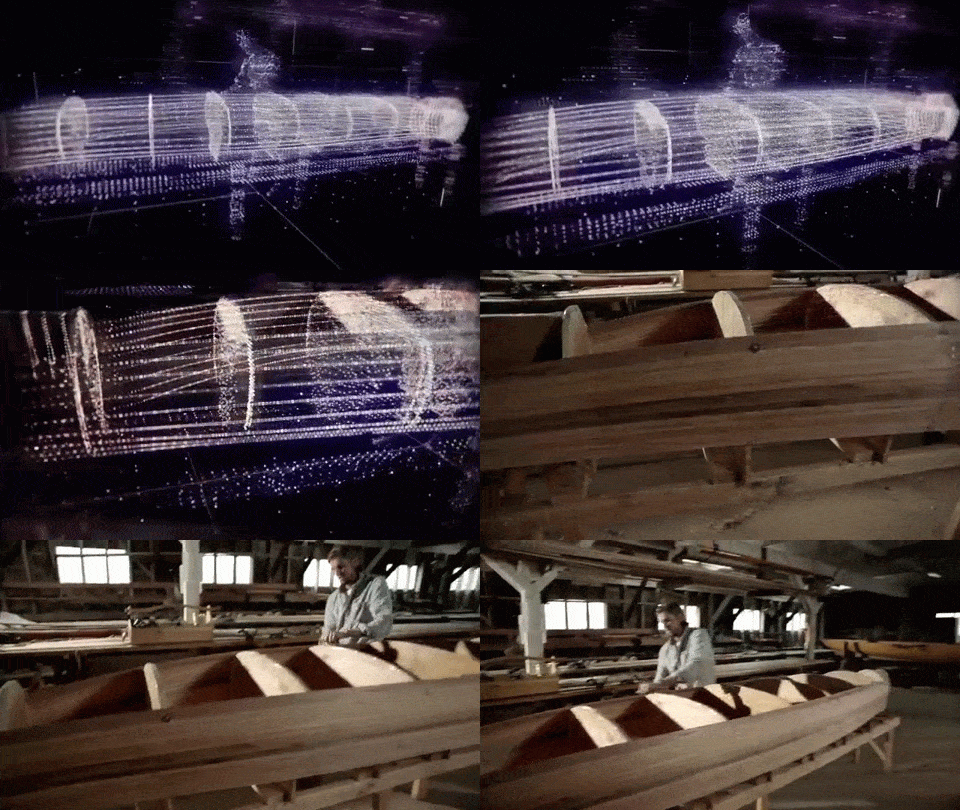
What it is: Most virtual reality cameras capture a static scene in 360 degrees, which presents two limitations: you can't navigate within a scene, and the crew on set will almost always be in the shot. The new Lytro VR camera lets users move around within the experience (i.e. moving your head will let you get closer and further away from an object in a scene) and can be operated remotely, so the crew remain out of the shot.

Why it's important: While the Lytro camera will revolutionize how VR footage is captured in the short term, it's also got promising potential for super-realistic video games and other media experiences. "We're capturing all the depth and the 3D geometry of the real world, so compositing computer-generated objects...becomes much easier than it's ever been before," explains Lytro CEO Jason Rosenthal.

Spotted by Marissa Brassfield

Graphene-Enabled Goggles Will Revolutionize Night Vision

ALT

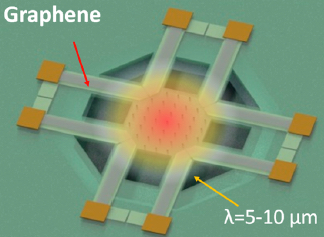
What it is: Here's a new and amazing application of graphene that enables massively advanced night vision goggles. Researchers at MIT, Harvard and the Army Research Laboratory have developed an advanced device by integrating graphene with silicon microelectromechanical systems (MEMS) to make a flexible, transparent, and low-cost device for the mid-infrared range.

Why it's important: Breakthroughs in material sciences are key for the next decade, and will affect sensors, robotics and 3D printing, creating new and magical capabilities. Infrared imaging is just one example, but it's a critically important one. Humans only see a minute portion of the spectrum. Seeing in other bands will enable us incredible powers that will impact emergency response.

Spotted by Peter Diamandis

Vertical Seaweed Gardens Let Us Feed Ourselves From Overfished Oceans

ALT

What it is: Bren Smith has created a multi-species 3D ocean farm that grows scallops, muscles, clams, oysters, and seaweed -- crops that produce fertilizers, feeds, cosmetics, biofuels and, of course, food. GreenWave won this year's Buckminster Fuller Institute prize for its creative solution to overfishing and ocean pollution (seaweed also helps clean polluted water of carbon dioxide and nitrogen).

Why it's important: Another example of an entrepreneur transforming scarcity into abundance. GreenWave has created a sustainable aquaculture practice that provides food and essential everyday goods while also cleaning our oceans.

Spotted by Marissa Brassfield

Transformative Touch Interface ID's Any Object in Your Hand

ALT

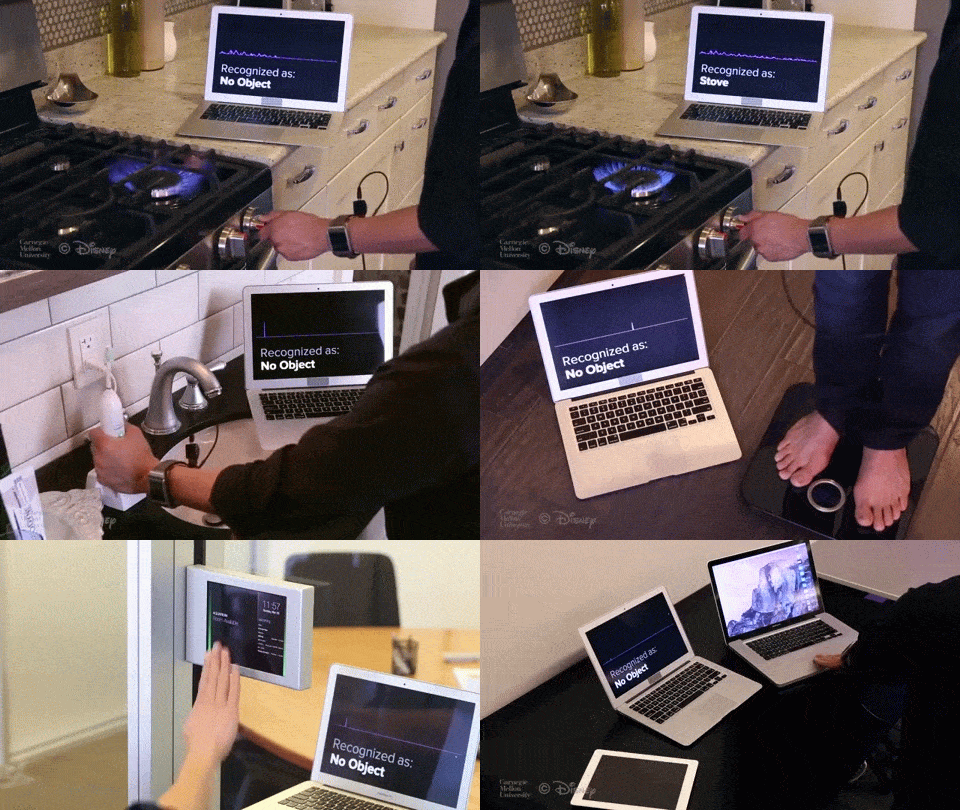
What it is: Disney Research is working on robust on-touch object detection by modifying a small, inexpensive, software-defined radio to pick up on the trace amounts of electromagnetic signals that most electrical and electromechanical objects emit. When a user wears the EM-Sense sensor -- say, on a smartwatch -- it detects any object the user touches, from door handles to laptop trackpads and drills.

Why it's important: When you can digitize touch and tactile sensation, you enable a multitude of new human capabilities. Imagine office doors or specialized equipment that only operate on the touch of an authorized employee (as verified by his/her touch and paired smartwatch).

Spotted by Cody Rapp

Google Releases Open-Source AI Engine

ALT

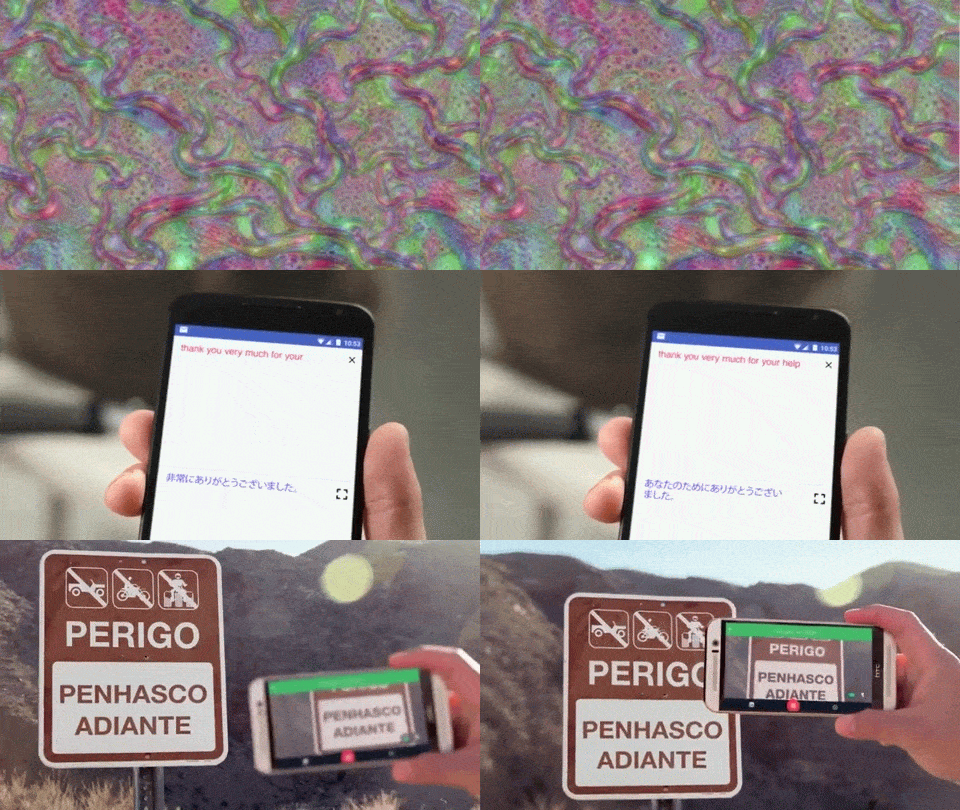
What it is: Google has made one of its core creations, an AI tool called TensorFlow, open source. TensorFlow relies on graphics processing units, or GPUs, which were originally designed to render graphics for games -- a significant shift from systems that run on traditional computer processors, or CPUs.

Why it's important: Open-source accelerates technological progress. By open-sourcing the TensorFlow AI engine, Google dematerializes its machine learning research and demonetizes access to artificial intelligence. Now, anyone with a smartphone can begin training AI models.

Spotted by Marissa Brassfield

Create Your Own 3D Printed Walking Robot, No Engineer Needed

3d printed walking robot

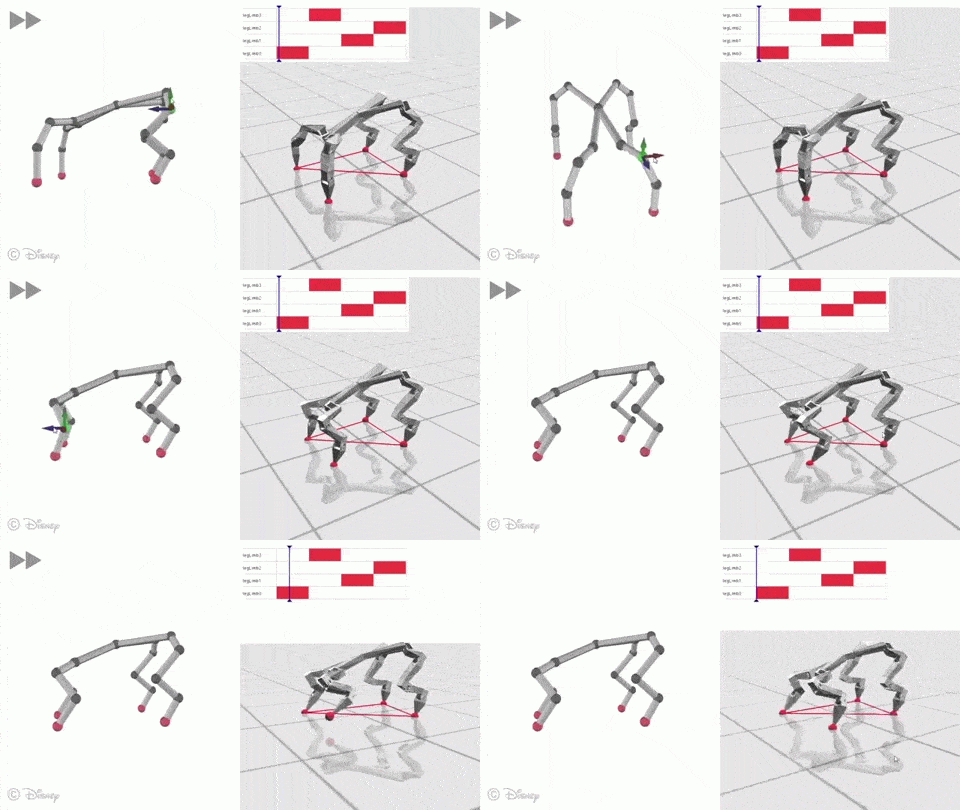
What it is: Disney Research and Carnegie Mellon University have created a new DIY tool that allows people to customize their own 3D printed walking robots. The intuitive editing tools automatically generate 3D printed parts that enable you to alter the robot's structure and motion without compromising the robot's ability to walk effectively.

Why it's important: Historically, only experienced engineers could build a functioning robot. This interface enables any maker or enthusiast to create a personalized robot that looks, walks and behaves exactly as you desire. With Disney's involvement, expect to see truly personalized DIY robots easy enough for a child to configure and create at home.

Spotted by Marissa Brassfield

Fastest 3D Printed Drone Flies at Up to 150 MPH

ALT

What it is: Aurora Flight Sciences and Stratasys Limited recently unveiled the first 3D printed, jet-powered aircraft. Weighing in at 33 pounds, the drone travels at speeds up to 150 mph, making it the fastest 3D printed drone to date. What's more, the build time for this drone was 50 percent less than that of Stratasys' previous projects.

Why it's important: The convergence of 3D manufacturing and unmanned aerial vehicles enables us to locally create drones and drone parts on an as-needed basis.

Spotted by Marissa Brassfield

Crowdfunded Public Transportation Puts Passengers in Charge

ALT

What it is: Locomore is a new open-access passenger service that will run between Berlin and Stuttgart significantly faster than a long-distance bus. It will run on renewable energy and have fair trade catering onboard, but what's most interesting about Locomore is that a large portion of its €450,000 in startup costs will come via crowdfunding.

Why it's important: Most public works are funded by the government and subsidized by taxpayers. This crowdfunded model not only covers startup costs, but also enables supporting passengers to participate in profit-sharing and even get tickets via microloan.

Spotted by Clyde R. Dennis

Understanding Poverty Through Satellite Data and Artificial Intelligence

ALT

What it is: Data analytics firm Orbital Insight is partnering with the World Bank to quantitatively measure global poverty using satellite imagery and aritificial intelligence. Historically, governments and developed organizations have measured poverty through door-to-door surveys, and the World Bank says that over 50 countries lack legitimate poverty estimates -- which in turn hampers support efforts.

Why it's important: We're moving towards a world where we'll be able to see high-res images of every inch of the planet. Combine this data with artificial intelligence, and we have better decision-making insights than ever before on everything from business and policy to resource management and disaster response.

Spotted by Marissa Brassfield

Nanoparticle Spray Boosts Tomato Plant Yields by Over 80%

ALT

What it is: Researchers from Washington University have developed a nanoparticle spray using zinc oxide and titanium oxide that boosts tomatoes' nutritional value. Instead of genetically modifying the plant, the nanoparticles boost the plant's built-in growth mechanisms, helping it absorb more sunlight and better use ground minerals. Treated tomato plants produced 82 percent more fruit than untreated plants, and the tomatoes themselves had up to a 113 percent increase in the antioxidant lycopene.

Why it's important: This promising application of materials science shows how we can produce more food without using more resources like water or energy. The Washington University researchers plan to iterate this spray by adding all 17 elements that a plant needs to grow, according to Digital Trends.

Spotted by Marissa Brassfield

What is Abundance Insider?

This email is a briefing of the week's most compelling, abundance-enabling tech developments, curated by Marissa Brassfield in preparation for Abundance 360. Read more about A360 below.

Want more conversations like this?

At Abundance 360, Peter's 250-person executive mastermind, we teach the metatrends, implications and unfair advantages for entrepreneurs enabled by breakthroughs like those featured above. The program is highly selective and we're almost full, but we're still looking for a few final CEOs and entrepreneurs who want to change the world. You can apply here.

Know someone who would benefit from getting Abundance Insider? Send them to this link to sign up.


If you wish to stop receiving our emails or change your subscription options, please Manage Your Subscription
PHD Ventures , 800 Corporate Pointe, Culver City, CA 90230


Tuesday, November 10, 2015

Fwd: How Surfing Made Me A Better Investor


---------- Forwarded message ----------
From: John Greathouse <noreply+feedproxy@google.com>
Date: Tue, Nov 10, 2015 at 3:15 AM
Subject: How Surfing Made Me A Better Investor
To: stevescott@techacq.com


How Surfing Made Me A Better Investor


How Surfing Made Me A Better Investor

Posted: 09 Nov 2015 05:00 AM PST

image001

A version of this article previously appeared on the Wall Street Journal.

As crazy as it sounds, surfing has made me a better investor. The sport involves a surprising amount of downtime between sets. During the many hours I have stood in anticipation of the next wave (as noted in You're Never To Old To Learn To Surf, I'm an old guy on a standup paddle board), I have come to realize that surfing and investing share a number of surprising corollaries.

If you haven't already subscribed yet,
subscribe now for free weekly JohnGreathouse.com articles!

Gnarly Corollaries Between Surfing And Investing

  1. Biggest Sets – No matter how flat the water may currently be, there is always another wave brewing further off the coast. The largest sets of wave typically appear after the longest lulls in activity. Patience rewards both surfers and investors.
  2. Last Wave – Novice surfers chase the previous wave, rather than anticipating where the next waves will break. Seasoned surfers develop an eye for swells which subtly build in the distance, just as experienced investors anticipate future trends, instead of following current ones.
  3. Location Matters – Some surf breaks are more consistent and offer more rideable waves than others. Unfortunately, investors and surfers can be lemmings, which results in good breaks getting over surfed and market sectors attracting too much capital. Like surfers, investors should similarly be willing to invest off the beaten path.

Knowing when to break the rules of your investment thesis can lead to big wins. For instance, at Rincon Venture Partners, we typically do not invest in consumer facing companies. However, we made an exception at Tradesy, because we were so impressed with its Founder, Tracy DiNunzio. Although the venture's journey is not completed, we are very pleased that we deviated from our traditional b-to-b SaaS focus.

  1. All In – Once it is your turn in the lineup, make the most of your ride. If you bail on a rideable wave, you may have to wait an extended period for another opportunity and it is unlikely your fellow surfers will forgive the fact that you let a good wave pass by. Likewise, investors who quickly abandon struggling companies seldom prosper because the entrepreneurial community knows that they cannot be counted upon when the going gets tough.
  2. Hard – Surfing is more difficult than it looks. When done well, the surfer appears to be in a relaxed, Zen-like state. Likewise, successful investing appears to the casual observer to be easy in hindsight. It isn't. I have turned down opportunities to invest in several companies that later proved to be huge successes. However, at the time I reviewed the deals, the opportunities did not appear to be credible, let alone lucrative.
  3. Sharing – Many surfers do not want to share their waves. However, riding a wave with another skilled surfer can be fun and challenging, requiring each rider to cut back and forth in syncopation. In a similar fashion, some old-school investors attempt to push other investors out of their deals. I prefer a collaborative approach whereby we build syndicates of like-minded investors. This results in a more stable capital pool for the company and a Board with a greater diversity of backgrounds, which leads to more informed decisions.
  4. Luck – Beginning surfers point their boards toward the shore and randomly paddle when a set appears. This strategy occasionally works, when the timing and momentum of a wave allows the neophyte to get a ride. Although this is a legitimate way to learn basic surfing skills, catching a wave in this manner should not be confused with knowing how to surf. This is equally true in investing world, where achieving sporadic success via a "spray and pray" strategy does not equate to mastering the art of investing.
  5. Practice – Surfing is an experiential, not an academic, exercise. Time in the water matters. Trying, failing and trying again is the only way to become a proficient surfer. Investing is a similarly hands-on affair. Self-aware investors relish their mistakes, knowing that each setback contributes to their ultimate success.
  6. Harsh Self-awareness – Understanding why you missed a wave is crucial. It is impossible to avoid future mistakes if you don't understand why you failed or if you constantly blame exogenous forces (this board sucks, these waves are weak, etc.). Correspondingly, in both surfing and investing, learning from your mistakes requires intellectual honesty and removing your ego from the outcomes.
  7. Aggressive Yet Friendly – Mature, self-assured surfers exhibit a congenial demeanor with their fellow riders, yet they also assert their position in the lineup and do not allow others to knock them off a wave. In the same vein, investors should also work collaboratively, but not shy away from potential conflicts.
  8. Once A Snake – When a surfer takes off in front of one of their brethren and steals a wave, it is called "snaking." In both surfing and investing, if someone snakes you once, they will do it again. Don't invest (or surf) with snakes.
  9. Kelp Reading – Skilled surfers watch the kelp which lies beyond where waves the break. The subtle rise and fall of the kelp alerts the knowing eye as to where and when a swell will form. This ability allows the surfer to select which waves to pursue. Poor wave selection results in a frustration day of surfing. Veteran investors develop a similar ability to read markets, ignoring overly hyped fads, while investing in long-term, sustainable trends.
  10. Position – Wave selection is important, but if coupled with poor positioning, the novice surfer will spend most of her day chasing waves the role under her and getting pummeled by waves which crash into her. Experienced surfers anticipate where and when a wave will peak and begin to curl, just as successful investors understand that properly timing their entry into an emerging market can significantly improve their chances of success. For instance, numerous investors lost hundreds of millions for over a decade in the ever-emerging mobile Internet space. It wasn't until 2007 that the iPhone finally cracked the code and made handheld Internet surfing a reality.

14. Proprietary Surf – Surfing is intrinsically competitive, as surfers often outnumber the rideable waves. This reality has fueled the creation of surf havens, like Hollister Ranch, which offer owners year-round, nearly flawless surf, while keeping non-owners out. Investing is similarly competitive, which is why savvy investors create trusting relationships with entrepreneurs to ensure a constant flow of proprietary deals.

Follow John's startup-oriented Twitter feed here: @johngreathouse. I promise I will never Tweet about trendy bars or that killer burrito I just ate - just startup stuff.

Image: FREDERIC J. BROWN/AFP/Getty Images

Share and Enjoy

LinkedInFacebookTwitter

The post How Surfing Made Me A Better Investor appeared first on John Greathouse.

You are subscribed to email updates from John Greathouse.
To stop receiving these emails, you may unsubscribe now.
Email delivery powered by Google
Google Inc., 1600 Amphitheatre Parkway, Mountain View, CA 94043, United States

Sunday, November 8, 2015

Fwd: disrupting today’s healthcare system


-------- Forwarded Message --------
Subject: disrupting today's healthcare system
Date: Sun, 8 Nov 2015 10:04:42 -0800
From: Peter Diamandis <peter@diamandis.com>
Reply-To: peter@diamandis.com
To: STeve <stevescott@techacq.com>


This week in San Diego, Singularity University is holding its Exponential Medicine Conference, a look at how technologists are redesigning and rebuilding today's broken healthcare system.

Healthcare today is reactive, retrospective, bureaucratic and expensive.

It's sick care, not healthcare.

This blog is about why the $3 trillion healthcare system is broken and how we are going to fix it.

[ Click to Tweet about this (you can edit before sending): http://ctt.ec/KWYB9 ]

First, the Bad News:

  • Doctors spend $210 billion per year on procedures that aren't based on patient need, but fear of liability.
  • Americans spend, on average, $8,915 per person on healthcare – more than any other country on the planet.
  • Prescription drugs cost around 50% more in the U.S. than in other industrialized countries.
  • At current rates, by 2025, nearly ¼ of the US GDP will be spent on healthcare.
  • It takes on average 12 years and $359 million to take a new drug from the lab to a patient.
  • Only 5 in 5,000 of these new drugs make it to human testing. From there, only 1 of those 5 is actually approved for human use.

And Now, the Good News:

We are in the midst of a (medical) revolution driven by exponential technology: artificial intelligence, sensors, robotics, 3D printing, big data, genomics and stem cells. Today's $3 trillion healthcare industry is in the deceptive phase of its march towards dematerialization, demonetization and democratization. What does that mean? Imagine a time within the next 10 years when:

  • AI-enabled autonomous health scans provide the best diagnostics equally to the poorest and wealthiest on Earth.
  • Large-scale genomic sequencing and machine learning allow us to understand the root cause of cancer, heart disease and neurodegenerative disease and what to do about it.
  • Robotic surgeons can carry out a perfect operation (every time) for pennies on the dollar.
  • When each of us can regrow a heart, liver, lung or kidney when we need it instead of waiting for the donor to die.

These breakthroughs are materializing because of the convergence of the following key accelerating technologies.

Artificial Intelligence (AI) & Healthcare:

AI will enable better diagnoses and personalized medical recommendations.

  • Companies like Enlitic are using AI and deep learning to improve medical imaging diagnostics and tumor detection and integrate medical data to provide better actionable advice for patients and doctors alike.
  • Johnson & Johnson is teaching IBM Watson to read and understand scientific papers that detail clinical trial outcomes. Even Apple is partnering with IBM Watson to provide access to health data from mobile apps.
  • One such Watson system contains 40 million documents, ingests an average of 27,000 new documents per day, and provides insights for thousands of users. After only one year, Watson's successful diagnosis rate for lung cancer is 90 percent, compared to 50 percent for human doctors.

Sensors & Healthcare:

Wearables, connected devices and quantified-self apps will allow us to collect enormous amounts of useful health information.

  • Wearables like the Quanttus wristband and Vital Connect can transmit your electrocardiogram data, vital signs, posture and stress levels anywhere on the planet.
  • Google is developing a full range of internal and external sensors (i.e. Google's smart contact lens) that can monitor the wearer's vitals ranging from blood sugar levels to blood chemistries.
  • The $10M Qualcomm Tricorder XPRIZE is bringing the Star Trek Tricorder to life – not for a doctor or nurse, but for you, the consumer.

Robotics & Healthcare:

The precision, accuracy, and mobility of medical robotics will allow us to serve more humans around the world, faster and cheaper.

  • Over 3 million surgeries worldwide have been performed by Intuitive Surgical's Da Vinci robotic system using 3D HD vision inside the body, with precise movements that don't have the tremors of a human hand.
  • A new generation of surgery robots under development which can autonomously and perfectly conduct routine surgeries without human error and at a fraction of the cost, demonetizing and democratizing surgery.
  • Telepresence technologies like Suitable Technology's BEAM and InTouch Health will allow top physicians to beam into locations around the world for consultation and rounds at hospitals.

3D Printing:

On-demand manufacturing will make medical devices cheaper and more readily accessible to millions, and it will make scarce resources like organs-for-transplant abundantly available.

  • 3D Systems is 3D printing precise dental and anatomical models, custom surgical guides, implantable devices, exoskeletons, hearing aids, prosthetics and braces for scoliosis and other applications.
  • Students at Washington University 3D printed a robotic arm for about $200. Traditional robotic limbs can run $50,000 to $70,000, and they need to be replaced as children grow.
  • Dr. Anthony Atala's team and companies like Organovo are 3D bio-printing with cells to produce tissues, blood vessels and even small organs.

Genomics & Big Data:

The cost of genome sequencing has plummeted 100,000-fold, from $100M per genome in 2001 to $1,000 per genome today… outpacing Moore's Law by 3x.

  • At Human Longevity Inc., our mission is to accumulate the largest genomics data set ever. HLI will sequence over 1 million full human genomes, microbiomes, MRI body image scans, metabolomes, and more…
  • Next, with that large data set, HLI be able to unlock the secrets of our biology. We'll find insights into and cures for cancer, heart disease and neurodegenerative disease, and ultimately extend the human lifespan.

Stem Cells:

We are now in the earliest stages of stem cell therapy development. Future therapies will be transformative and, frankly, mind-boggling.

  • Stem cell therapy promises tissue regeneration and renewal – and thus a "cure" for everything from blindness to spinal cord injuries, Type 1 diabetes, Parkinson's disease, Alzheimer's disease, heart disease, stroke, burns, cancer and osteoarthritis.
  • In 2012, researchers at Cedars-Sinai reported one of the first cases of successful therapeutic stem cell treatment – they used patients' own stem cells to regenerate heart tissue and undo damage from a heart attack.

Conclusions

The disruption and transformation of medicine is happening right now.

That's why each year I work with Dr. Daniel Kraft, head of the Medicine track at Singularity University, to hold an amazing 3-day event that brings all of the coolest and most powerful technologies together at an event called Exponential Medicine.

If you are interested in or involved in medicine, technology, or the future of healthcare, you need to be at this event.

Join Me

This is also the sort of conversation we explore at my 250-person executive mastermind group called Abundance 360.

The program is highly selective and currently full. If you'd like to be considered for the waitlist, we are looking for a few last CEOs and entrepreneurs who want to change the world. We imagine a few spots will open up over the next few months. You can apply here.

Share this with your friends, especially if they are interested in any of the areas outlined above.

P.S. Every week I send out a "Tech Blog" like this one. If you want to sign up, go to Diamandis.com and sign up for this and Abundance Insider.

P.P.S. I've just released a podcast with my dear friend Dan Sullivan called Exponential Wisdom. Our conversations focus on the exponential technologies creating abundance, the human-technology collaboration, and entrepreneurship. Head here to listen and subscribe: a360.com/podcast


If you wish to stop receiving our emails or change your subscription options, please Manage Your Subscription
PHD Ventures , 800 Corporate Pointe, Culver City, CA 90230


Avast logo

This email has been checked for viruses by Avast antivirus software.
www.avast.com