Tuesday, December 12, 2017

Fwd: 6 Steps Toward Procrastination Freedom


Hello,

6 Steps Toward Procrastination Freedom

  1. The phrase a founder hates to hear from his team? "I'll do it tomorrow."
  2. The phrase a founder lives to hear from his team? "I did it already."

But how do we get from A to B? Well, it's pretty simple. DELEGATE.

Delegate everything you don't truly need to do yourself — trust me, more things fit under that umbrella than you realize…no less than 90% of your day can be delegated to someone else.

Is delegation without its flaws? Absolutely not.

But those flaws are few and far between compared to the stress, disorganization, and overwhelm associated with "I'll do it tomorrow" procrastination.

Delegation can come in a variety of forms depending upon your situation. For me, delegation comes almost exclusively in the form of my team here at Less Doing.

They help me navigate around the common triggers of procrastination

  • Boredom
  • Lack of motivation
  • Distraction
  • Overwhelm
  • Uncertainty of success

…and help me get things done. Are those completed tasks always perfect? Not always, but at least they're a step in the right direction, a building block to something better.

If you refer to the above graphic, you'll get a good visual sense of the levels of delegation. There is not one optimal approach and the level at which you delegate will depend on the task.

A good way to begin using this strategy is by applying it to your inbox. Ask yourself, "Do I need to do this now? Can it wait? Can someone else handle it? Once you have determined those parameters, you can them figure out how involved you need to be in the process. If your work environment is built on mutual respect, and you're willing to give your ego a rest, you'll be amazed how little you actually have to oversee.

More importantly, when delegating all excess in my day, I'm creating the mental and physical space necessary to work on what I'm fantastic at — being a husband, father, and helping other people improve their lives.

As you start to get more comfortable with delegation, you'll slowly notice your schedule freeing up as your day becomes less mired in the tasks other people can do. You'll also notice that, as you prepare tasks for delegation, your focus will sharpen — you'll start thinking and working ON your business, rather than IN it.

You'll enjoy the headspace to honestly evaluate state of your business (or your life) and where you want to go next. When you're ready to make the leap from delegation amateur to delegation aficionado, be sure to employ tools that will increase your efficacy, including:

  • Trello — the best workflow and project management tool out there
  • Slack — a bastion of highly-effective asynchronous communication
  • Evernote and Dropbox — cloud-based tools that allow you to store and share anything and everything surrounding your delegation

We operate at Level 6 delegation here at Less Doing.

More often than not, when I circle back around to see how one of my team members is doing on a particular project, I hear that wonderful, life affirming, getting shit done sentence,

"I did it already."

And there are few things better than hearing that.

Hey if you'd like to hear me talk about this and more, check me out at the COO Alliance, this week in Phoenix.


Signed Ari Meisel
Ari

P.S. In the meantime, check out the four effective ways I can help you reclaim your time.

  1. Listen to the Less Doing Podcast. Every week, I offer advice on how to be more productive and overcome challenges such as managing your email, staying focused, and how to master the art of delegation. Find it here on iTunes.
  2. Join the Less Doing Labs on Facebook or Slack. It is a community of efficiency-minded entrepreneurs and industry leaders who want to 10x their productivity. Get expert tips, tricks, and tools to help you get more done, and join a monthly webinar with me where we dig into the top productivity challenges.
  3. Want even more tools, resources, and practical advice? Join the Less Doing Labs Premium on Slack, and get access to over 200 hours of exclusive resources to include our video library, Process Hacker Live webinars, and the members-only OAO podcast. This group is for those who are serious about applying the Optimize, Automate, Outsource methodology to their lives and business. Send us an email with "Premium" in the subject line for more information
  4. If you are really committed to taking your life and business to the next level, focusing only on your unique ability, and doing less so you can live more; the Less Doing Group Coaching program is for you. This allows you to dissect your processes to optimize, automate, and outsource your life and business alongside the Less Doing Team and other Less Doing trained and certified coaches. Get the accountability and expertise of our small expert group as well as exclusive resources like one-on-one calls with the team, member "hot seat" discussions, and twice-monthly roundtable discussions with me. If you think this group is for you, send us an email with "Coaching" in the subject line, and we'll get connected.


Unsubscribe | Less Doing, 51 Jay St, 1k, Brooklyn, NY 11201

Sunday, December 10, 2017

Fwd: Knowledge vs. Ignorance


Hi Steve,

A new member of The Marketing Rebel Insider's Club posted a question a few days ago.

He asked about something a lot of marketers overlook entirely, so I thought I'd shared his question and my response with you.

Q: It seems becoming a copywriter of any note is not about being born great. It's much more about hard work and a little science. To that end, it seems to me that doing research is a huge part of the copywriting process. Any tips on how to get into good habits from the get-go?

My response:

Hi. Remarkably good question. Thanks for posting it.

Step 1 of The Simple Writing System is Market Research.

For an excellent reason: If you don't nail that, you're probably not going to write a very effective ad.

I've spent a lot of time with many hugely successful copywriters. One thing I've learned is the ones who have a proven they can write ads that create more sales than other ads, in different markets, spend more time – much more time – on researching the market than they do writing the ad.

They define, in detail, a typical ideal buyer (or two). Who they are. What they do with their days. What beliefs they have. Where they go (online and off). Who they talk to. What they read. What problems they have that this product solves.

They give this person a name. Let's call her Mary.

Then they immerse themselves in Mary's world. They go the websites Mary visits and study the language used there. If Mary is 60+, good chance she reads magazines and newspapers, so they get themselves a few issues of those.

If Mary typically shops at Walmart, off to Walmart they go. They listen to what Marys talk about. If there's a department that makes sense, they hang out there and try to get Mary talking about similar products. Why is Mary there today? What's up in Mary's life? What problem is she trying to solve today?

They look at ads from competing products and other products Mary might see and buy.

If there are websites where Marys with this problem go – support sites, groups, Reddit threads, comments left in product reviews – they go there and study the exact language Mary uses to describe the problem, its impact, and solutions.

They pay careful attention to the support advice offered, because most products are either a better version of what's out there, or a new/contrarian secret Mary hasn't heard about, yet.

Top copywriters take notes and notes and notes.

All the notes and research in the world probably aren't going to help you all that much if you don't know how to structure an ad.

There are just a handful of templates (outlines, models, whatever you prefer to call them) that work in direct response advertising. And an infinite number of ways to do it wrong.

On this topic, like every other, knowledge is finite. Ignorance and stupidity are boundless.

If you understand the fundamentals of copy and selling, putting the notes together into a winning ad takes relatively little time.

Fundamentals -- from basic to super advanced -- are what we teach in The Simple Writing System.

Stan


. . .

Isn't it time for you to learn all the steps the A-List copywriters know and use to create winning ads?

To have a successful professional look over your shoulder and give you personalized tips and feedback on every step?

Hop over to SimpleWritingSystem.com for all the details.

Including how you get 4 extra weeks of coaching for free.

And the payment plan that makes professional coaching fit into most every budget.

Cheers,

Stan Dahl
John Carlton's Biz Partner and Co-Creator of the Simple Writing System


You received this email because this address was entered on a website operated by Marketing Rebel LLC or Stan Dahl to request information about marketing and copywriting for small business owners and entrepreneurs.

If you did not enter this email address, or if you do not wish to receive emails from us in the future, please click on the unsubscribe link at the bottom of this message.

To contact me or a member of my staff, please go to www.MarketingRebelSupport.com and submit a ticket. Please do not reply to this email, as we do not monitor this address.

IMPORTANT: A lot of people have requested to receive email from Marketing Rebel. Because of that, even though we follow all of the laws and best practices, sometimes an overzealous spam filter grabs one of our messages to you. Please click here to learn how to whitelist our emails so they land in your inbox from now on.

 Change your email address & contact information here.

 Unsubscribe here (Warning! You will be permanently removed from all lists).

Marketing Rebel LLC 561 Keystone Avenue, #282, Reno, Nevada 89503, United States 1 (877) 398-5273


Friday, December 8, 2017

Fwd: Abundance Insider: December 8 Edition


In this week's Abundance Insider: Nanomaterial quantum encryption systems, 3D printing with bacterial ink, and Google's AI creates its own "child."

Cheers,
Peter, Marissa, Kelley, Greg, Sydney, AJ, Bri and Jason

P.S. Send any tips to our team by clicking here, and send your friends and family to this link to subscribe to Abundance Insider.

Nvidia Uses AI to Make it Snow on Streets That Are Always Sunny

What it is: Nvidia research has developed a new AI framework that allows systems to imagine what an image might look like under different conditions, such as what an always-sunny street might look like under 6 inches of snow. A General Adversarial Network (or GAN) — which combines two neural networks, one that creates an image and another that judges — has been used successfully to create fake celebrity faces and new clothing designs. Most of these previous methods, however, rely on images to be labeled. Nvidia's framework allows the GAN to work with unlabeled datasets, a major advantage that frees up time for AI researchers that would otherwise be spent on cleaning their training data.

Why it's important: Cleaning and labeling data is a time-consuming but critical piece of most AI systems, including those used in autonomous vehicles. Look for Nvidia's progress here to affect other AI frameworks, and increase use of other unsupervised learning methods. Share on Facebook

Spotted by Marissa Brassfield / Written by Jason Goodwin

Electric Cars Already Cheaper to Own and Run Than Gas or Diesel

What it is: A new study by the University of Leeds reveals that over four years, pure electric cars cost less than gas- or diesel-powered cars. Researchers evaluated factors like fuel, purchase price, depreciation, taxation, maintenance and insurance across four markets — California, Texas, the U.K. and Japan.

Why it's important: Currently, sales subsidies are driving the affordability of electric car ownership. The Leeds researchers predict that by 2025, electric cars without subsidies will be cheaper to own and run than internal combustion engine cars — thanks to converging advances in batteries, materials science and manufacturing.  Share on Facebook

Spotted by Marissa Brassfield / Written by Marissa Brassfield

Google Artificial Intelligence Creates Its Own AI Child

What it is: AutoML, an artificial intelligence system built by Google, has created its own "fully functional AI child" called NASNet, which can identify objects in photos and videos better than its manmade counterparts. As The Week reports, the open-source NASNet can "...identify objects in an image with 82.7% accuracy... an improvement of 1.2% over AI programs created by humans."

Why it's important: Google's hope is that by making NASNet open source, developers can use it to address unforeseen computer vision problems. As artificial intelligence develops, and self-replicating AIs proliferate, we'll encounter a new wave of ethics considerations — but will hopefully also be able to address challenges that were previously impossible. Share on Facebook

Spotted by Sydney Fulkerson / Written by Marissa Brassfield 

3D Printer Uses Ink Made From Live Bacteria

What it is: The Laboratory for Complex Materials at ETH Zurich has taken bacterial 3D printing to a new level. By culturing different bacterial types in a biocomptible hydrogel, they have created bacterial gel inks that can create items with living properties, such as masks or wraps for burn victims, or materials capable of detecting toxins. Not only does this create a structure that directs the bacterial activity for an extended duration, but the team has basically created an ink jet system that facilitates embedding multiple bacterial types in the material to fit different needs.

Why it's important: Here's yet another example of our exponentially expanding abilities in digitizing biological systems, as well as illustrating that 3D printing goes far beyond printing LEGO parts and even manufacturing on demand. Share on Facebook

Spotted by Marissa Brassfield / Written by Jason Goodwin

High Fidelity Launches Avatar Island With Blockchain-Based Economy

What it is: High Fidelity has just released Avatar Island, a commerce system built on the blockchain that enables users to buy and sell goods in virtual reality. Currently, users can purchase over 300 virtual goods for their avatars in High Fidelity, all created by digital artists who will earn a share of the revenue.

Why it's important: High Fidelity CEO Philip Rosedale notes that this is the first blockchain used for virtual world commerce — and foresees this system becoming a bridge between the real and virtual worlds. "You might buy a pair of shoes for your avatar in the virtual world and receive an unfalsifiable coupon for the same pair of shoes in a real store," writes VentureBeat. How will retail stores evolve in an age of digital and virtual commerce? Share on Facebook

Spotted by Marissa Brassfield / Written by Marissa Brassfield 

New Nanomaterial Quantum Encryption System Could Be Ultimate Defenses Against Hackers

What it is: Two recent developments are giving us a leg up in the race against hackers. At NYU, researchers have created a molybdenum nanomterial that cannot be cloned. The material has the highest possible structural randomness possible, which means the way it emits or does not emit light gives it a unique cryptographic key which could be embedded in systems at the chip level. Separately, Duke, The Ohio State University and Oak Ridge National Laboratory have created a QKD (Quantum Key Distribution) like what we have seen in China earlier this year, but at speeds in the megabyte per second range, a 5-10X improvement that makes the method on par with current Internet speeds.

Why it's important: Trust and security is a huge challenge in the information age, but between blockchain, QKD, and application of materials science, we're entering an era where this will be rendered moot. Share on Facebook

Spotted by Marissa Brassfield   / Written by Jason Goodwin

What is Abundance Insider?

This email is a briefing of the week's most compelling, abundance-enabling tech developments, curated by Marissa Brassfield in preparation for Abundance 360. Read more about A360 below.

Want more conversations like this?

At Abundance 360, Peter's 250-person executive mastermind, we teach the metatrends, implications and unfair advantages for entrepreneurs enabled by breakthroughs like those featured above. We're looking for CEOs and entrepreneurs who want to change the world. The program is highly selective. If you'd like to be considered, apply here

Know someone who would benefit from getting Abundance Insider? Send them to this link to sign up.

PHD Ventures   800 Corporate Pointe  Suite 350  Culver City,  California   90230   United States

You received this email because you are subscribed to Abundance Insider from PHD Ventures.

Update your email preferences to choose the types of emails you receive.

 Unsubscribe from all future emails 


Friday, November 17, 2017

Fwd: Abundance Insider: November 17 Edition


In this week's Abundance Insider: AI fashion consultants, 3D printed fully functional electronic circuits, and editing genes inside the body.

Cheers,
Peter, Marissa, Kelley, Greg, Sydney, AJ, Bri and Jason

P.S. Send any tips to our team by clicking here, and send your friends and family to this link to subscribe to Abundance Insider.

Drones Help French Traffic Cops

What it is: In Bordeaux, France, police are using drones to monitor roadways and flag traffic violations. When they spot a traffic violation using the drone's camera, officers can track the vehicle before sending traffic cops to stop the vehicle. Since the trial began in the summer of 2017, they've stopped as many as 15 to 20 cars per hour and handed out "hundreds" of fines.

Why it's important: If autonomous cars don't break laws, cities won't be able to earn revenue from traffic violations. Until then, tech-savvy police forces will leverage drone and sensor technology to cover more ground better, faster, cheaper and easier than ever before. (The U.K., for example, already has a 24-hour drone unit.) Unsafe drivers and thieves — consider your days numbered.   Share on Facebook

Spotted by Marissa Brassfield / Written by Marissa Brassfield

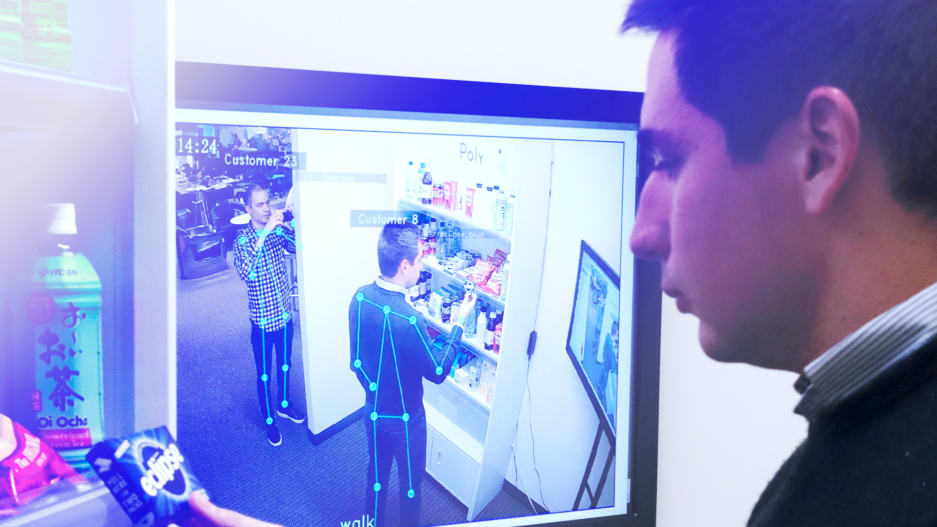
This AI Startup Wants to Automate Every Store Like Amazon Go

What it is: San Francisco-based startup Poly is hoping to help all retail stores become like Amazon Go, the experimental unmanned grocery store. Fast Company had an exclusive preview of the technology, which includes a camera system and machine learning models that track customers' behavior.

Why it's important: We're rapidly entering an age of perfect knowledge — know anything, anywhere, anytime. Platforms like Poly could help millions of businesses digitize their workforce, understand their customers' habits and feelings, and provide a frictionless retail experience. As cofounder Alberto Rizzoli said to Fast Company, "We want [Poly] to be used in places that are not just products on shelves. Like, how many people are using the coffee machine at a 7-Eleven, or how many people are using the gas pump."  Share on Facebook

Spotted by Marissa Brassfield / Written by Marissa Brassfield  

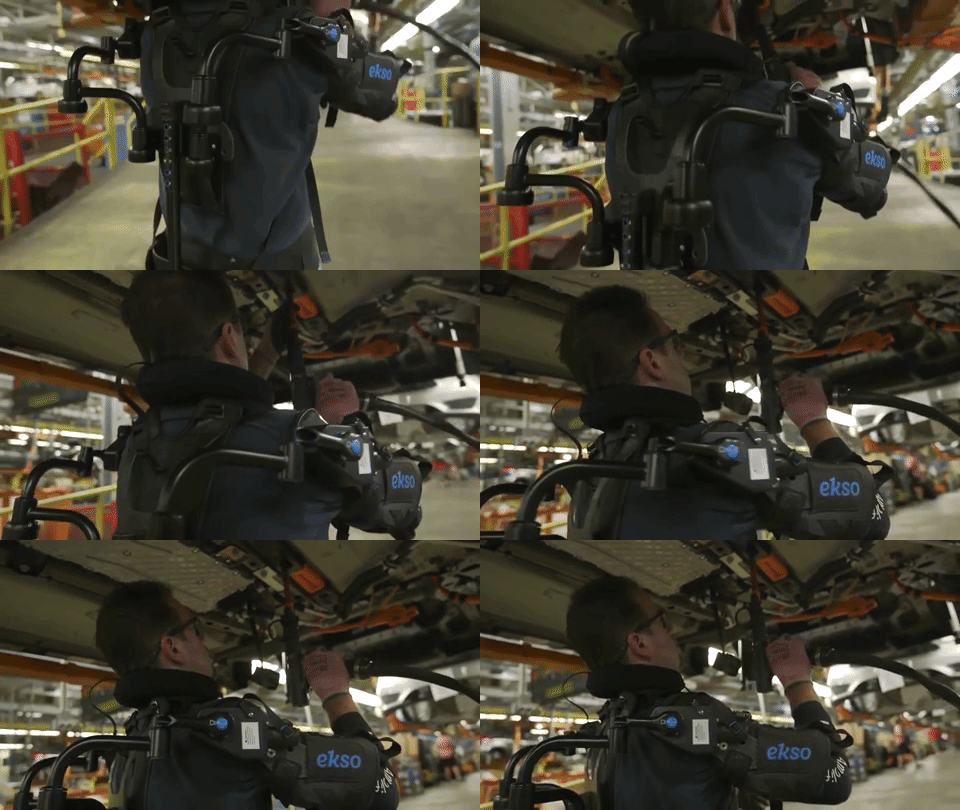
Ford, Ekso Team Up for Bionic Auto Workers

What it is: Ford, startup company Ekso Bionics, and the United Auto Workers Union have teamed up to bring bionics to the assembly line. To reduce worker injuries, particularly shoulders, Ekso created the EksoVest, which provides around 15 pounds of lift support per arm. The four workers who have been testing the vest no longer need to ice their necks multiple times per week, feel better overall, and are more energetic during their shifts and afterward. Next, Ekso plans on bringing in powered exoskeletons to do more of the heavy lifting now that workers are becoming accustomed to the feel of the vest.

Why it's important: Despite the fear of robots eliminating jobs, there's still plenty of human work to be done, and combining robotics with worker safety and health seems like an great entry point. As these types of exoskeletons and use cases begin to emerge, look for the social dialogue to change, simultaneously accelerating change while also making the future a little less scary.  Share on Facebook

Spotted by Sydney Fulkerson  / Written by Jason Goodwin 

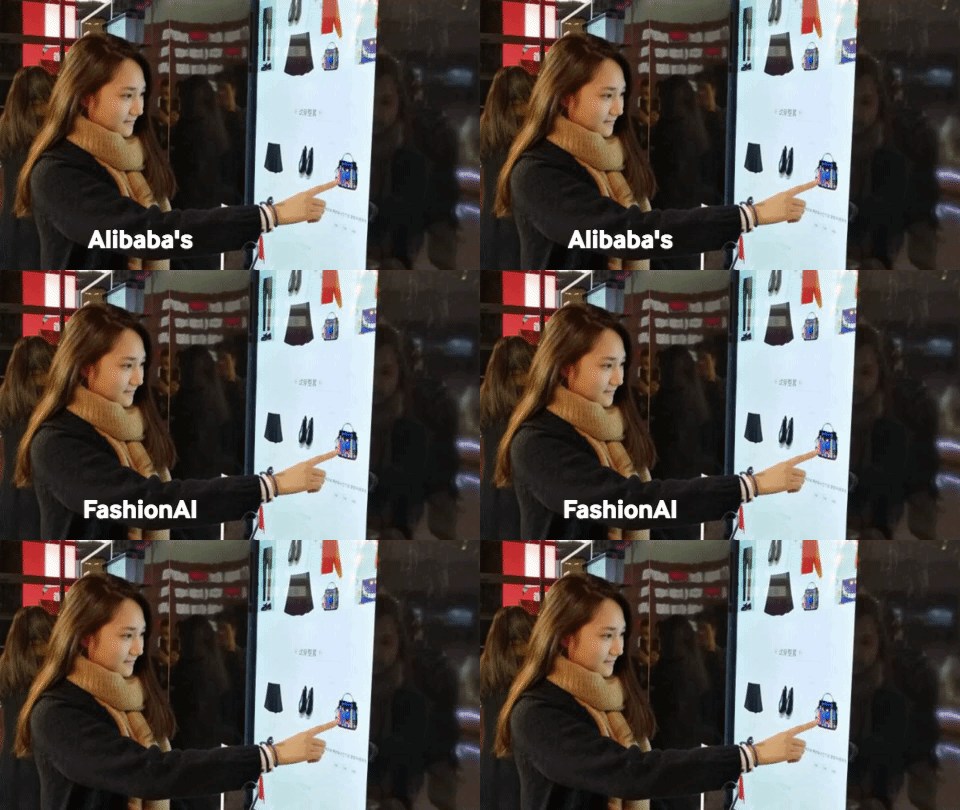
Alibaba's AI Fashion Consultant Helps Achieve Record-Setting Sales

What it is: At Alibaba's annual Singles' Day shopping festival, FashionAI helped drive a significant portion of the firm's $25 billion in sales (a new single-day record). The artificial intelligence system uses deep learning to make fashion recommendations based on the store's inventory and the tastes of fashion experts and designers on Alibaba shopping sites.

Why it's important: Exponential technologies are transforming retail — and consumers are clearly responding. Alibaba has announced plans for an app that offers unlimited matching suggestions, demonstrating how data and machine learning enable us to anticipate customer preferences and overdeliver. Share on Facebook

Spotted by Marissa Brassfield / Written by Marissa Brassfield 

New Method 3D Prints Fully Functional Electronic Circuits

What it is: At the University of Nottingham, researchers have devised a method for rapidly printing fully functional electronic circuits. The team discovered that UV light could be used to evaporate solvents in a silver nanoparticle conductive ink, enabling the fabrication of devices like antennae or solar storage cells at the rate of roughly one layer per minute. Earlier methods required heating the ink in an oven, layer by layer, which is impractical for devices that might require several hundred layers.

Why it's important: While we aren't currently able to print integrated circuits this way, we are discovering new methods of turning liquids, inks, and powders into 3D physical devices without massive amounts of energy or time. Look for startups and large corporations alike to incorporate these methods into their design and supply chains. Share on Facebook

Spotted by Marissa Brassfield / Written by Jason Goodwin

Scientists Make First Attempt at Editing Genes Inside Body

What it is: Using zinc finger nucleases, a method of gene editing similar to CRISPR-Cas9, scientists have made their first attempt at editing genes inside the body, hoping to cure the currently uncurable Hunter syndrome. By encoding the good gene and the zinc fingers into a virus modified to target the liver, the the team released billions of the good genes into the bloodstream, with a goal of correcting 1 percent of the cells to bring the 40-year-old Brian Madeaux some relief from daily medication. If successful, the team hopes to test out the treatment on children who have yet to feel the worst effects of the disease.

Why it's important: Radical healthy life extension is quickly becoming a reality. Even as this team continues to refine and focus on Hunter syndrome, look for this method to be applied elsewhere by other researchers, and for cross-pollination to accelerate discovery.  Share on Facebook

Spotted by Rick Beasley  / Written by Jason Goodwin

What is Abundance Insider?

This email is a briefing of the week's most compelling, abundance-enabling tech developments, curated by Marissa Brassfield in preparation for Abundance 360. Read more about A360 below.

Want more conversations like this?

At Abundance 360, Peter's 250-person executive mastermind, we teach the metatrends, implications and unfair advantages for entrepreneurs enabled by breakthroughs like those featured above. We're looking for CEOs and entrepreneurs who want to change the world. The program is highly selective. If you'd like to be considered, apply here

Know someone who would benefit from getting Abundance Insider? Send them to this link to sign up.

PHD Ventures   800 Corporate Pointe  Suite 350  Culver City,  California   90230   United States

You received this email because you are subscribed to Abundance Insider from PHD Ventures.

Update your email preferences to choose the types of emails you receive.

 Unsubscribe from all future emails