Thursday, May 12, 2016

Fwd: How To Tell If Someone Is Lying


---------- Forwarded message ----------
From: James Altucher <customerservice@thealtucherreport.com>
Date: Wed, May 11, 2016 at 2:45 PM
Subject: How To Tell If Someone Is Lying
To: stevescott@leadershippoint.com


"  I sat next to a spy on a plane ..."


How To Tell If Someone Is Lying

By: James Altucher

(Note: This post is a little bit long. You can read on site here.)


How To Write


Writing is really hard. Because it involves a skill like typing.


Everyone uses fancy things like "Scrivener" or "Microsoft Word." The next time I need 85 fonts and 172 formatting options to write, I will let you know.


I open up a "New Message" box on gmail. Gmail is part of Google, which is a company that sells Coke and Pepsi ads inside of videos.


I write in the New Message box then shift over to a Facebook status update.

Facebook is a company that asks: "Where are you from?" "What school did you go to?" "What is your favorite movie?" "When is your birthday?" To 1.65 billion people around the world.


My 14-year-old daughter asks those questions also when she meets people.


Those questions were written by a billionaire named Mark Zuckerberg.


Writing in a Facebook status update makes me keep each line as sparse as possible. It helps me rewrite.


Then I read the post out loud. If I sound stupid, I take a line out. I usually sound stupid repeatedly.


How to change your life for the better


Don't read email for 24 straight hours. Try it starting NOW.


How to ask a girl or guy out


Go up to them and ask them.


I feel like white people are the only ones who are not good at that. White people have a deformity which causes them to have less melanin in their basum stratale.


White people seem to have more shame. And we're not even white. We're pink people. Pink people seem to have more shame. Probably because we are pink.


As an aside, someone told me the other day that in the 1800s boys used to like pink and girls used to like blue.


But then another person said there is an evolutionary reason why girls like pink. It's because they were "gatherers" and they would gather strawberries.


Strawberries are somehow pink.


So everything I just wrote above makes total sense.


How to make a lot of money


Here is all the advice I've gotten in the past few days. I collect advice and try to figure out what to do with it later.


    • "If you want to make a million dollars, help a million people."
    • "If you want to make a million, go for ten million."
    • "Get up early, so you have an extra hour each day over your competition."

This is all decent advice. I don't know. I've never done any of it.


BUT, I can tell you what is common among all the people who gave me the advice.


Their network of contacts is huge. They stay in touch with hundreds of people and then when the time is right, they know how to put the right people together and they get a cut in the middle.


Sometimes the cut is a million dollars or more.


I try to add one person to my network every day. Maybe today I will add you.


How to meet the right spouse


In the past week, four people in great relationships gave me the exact same advice. I won't share their names because maybe they want to be private.


One person I will share because he gave the exact same advice in the middle of my podcast.


Brian Grazer. He produced A Beautiful Mind, Apollo 13, 8 Mile, etc. and my favorite TV series every Arrested Development.


He said, "Make a list of all the qualities you like." That's it. All of the other people said the exact same thing.


Two of them said, "I made this list and within six months I met the woman who matched every single quality."


Brian said, "They should be at least generous, warm, pretty."


He said, "Maybe look for a teacher or a nurse."


A friend of mine wrote me the other day, "Did you make your list yet?" I said,


"Yes, today." and he said, "I made my list."


I said to him, "this is the pinkest conversation two men are having right now."


How to say no


A friend of mine wanted to give me his new book. I said, "It can't fit in my bag."


I have one bag. I have zero other possessions in my life other than that one bag.


I put clothes in it and some cash. Just in case I need to escape the country, among other things I need to escape.


He laughed and said, "OK." He got it. So he sent me the digital form of the book. It was great.


Another person wrote me and asked if I wanted to meet for coffee. I didn't even respond.


Nothing wrong with not responding. Social media is a suggestion and not an obligation.


How to be more healthy


I wrote yesterday about health. But I have an easier way to be healthy.


In the past few months some bad things happened to me. I stopped eating 3 meals a day and I lost 25 pounds.


Now I am feeling very healthy. We all eat too much anyway. Sleep eight hours and eat half of what you normally eat.


So allow bad things to happen to you so you can start eating less, combined with explosive diarrhea and lots of depressing sleep and you will be more healthy.


It's all about calorie restriction.


How to know if someone is telling the truth


I sat next to a spy on a plane when I came back from visiting Brian Grazer in LA.


He had been CIA and a few other organizations. Now he runs his own private spy agency. Governments seem to pay him to spy on other governments.


He told me some of his non-classified stories. Some stories he couldn't tell me.


We spoke the whole plane ride. Six hours. I had non-stop questions. I think he wanted to sleep but I wouldn't let him.


He gave me advice on how to tell if someone is telling the truth. Actually he gave me a lot of advice on it but I will tell you one.


If someone can't give you an answer, then they are lying.


For instance, "Where were you last night?"


"I was out with friends."


Note that they did not say where they were. They didn't even say who their friends were. So somewhere in there is deception.


"Don't leave without an answer. "


Maybe in another article I will tell you the other things this guy said. One of them involved chairs with balls on them so they can slide around a room.


How to recall everything


I can't remember anything. We had an embarrassing podcast the other day for my "Question of the Day" podcast.


I kept starting with a new topic. The producer would say from the other room, "We already did that."


I had to restart five times and it was almost becoming a joke except it was sad because I probably have some kind of dementia. Each start was: "We already did that."


Finally I found a topic I had never spoken about it before. Except, God's honest truth, I now forget what it was.


But here's what I do:


    • For everyone I talk to, I try to learn one thing.
    • Then I try to teach it within the next day.
    • Then I try to use it within the next day.

If you learn one life-changing thing a day, then you will learn 365 life-changing things a year. And the effect on your life will compound.


From Jesse Itzler I learned, "No matter where you feel maximum pain, you can always do 40% more."


So then I wrote about it.


And then I did 40% more push-ups after I thought I was going to collapse.


Don't try to learn more than one thing from any book or person. Don't stress it. It adds up.


Is it good to be mediocre?


I asked Stephen Dubner (Freakonomics and my co-host on "Question of the Day") to define "mediocre".


He thought it was a bad word to describe people. Many pink men think it's bad to be mediocre.


He thought about it for about 20 seconds and then said, "Mediocrity is being content without putting in maximum effort."


"Hmmm, I think I want that! You mean I can be CONTENT and not put any effort into being content. I think I want to be mediocre if that's the case."


He said, "Well, when you put it that way…"


Yeah, I PUT IT that way, BITCH!


      Sent to: stevescott@leadershippoint.com

      Unsubscribe

      Choose Yourself Media, 14405 W Colfax Ave #309, Lakewood, CO 80401, United States

      Sunday, May 8, 2016

      Fwd: disrupting solar


      ---------- Forwarded message ----------
      From: Peter Diamandis <peter@diamandis.com>
      Date: Sunday, May 8, 2016
      Subject: disrupting solar
      To: STeve <stevescott@techacq.com>


      <https://blogger.googleusercontent.com/img/proxy/AVvXsEhYeq0Psz89mikSauEN95v6lZ9wsIpFO6bAOrzJP-QCJJL7O68Biu23M4-bKd6OP2l-DRUlx1meeHtC_G0SiH6hts32l3_WRu0nYM-3Q6jBR4jiAu-Kxj2i7sT-kr_zbruold7UIKbnq4JIo9b_Bf75mTa9OQ8GMvbaIV5ID1mxrMTWmGX5ceBNR4DZPWh6PL-JvVIIppGhrVsa8CC0=s0-d-e1-ft&stn=0&cid=1180&mid=19779697&aid=22289&aaid=2&time=1462727046>

      In the next 20 years, between 50 percent to 100 percent of the world's energy production could come from solar.

      Today, the global oil and natural gas industry is about a $4 trillion business.

      It's big money, and in the U.S., 67 percent of the electricity generated in 2015 was from fossil fuels (coal, natural gas, and petroleum).

      This is about to change.

      We are on the cusp of a solar revolution where the cost of solar cells will plummet, efficiency will rise dramatically, and the incentives for widespread adoption will become compelling.

      This blog is Part 1 of 2 about the exciting developments happening in solar.

      Today, we'll focus on a recently discovered material called perovskite and its massive implications to society.

      Solar Today: Context

      Over the past few decades, the most widely used form of solar energy has come from a material called silicon.

      The silicon solar cell was discovered in 1953.

      A few years later, the first commercial solar cells began to pop up.

      Unfortunately, these first commercial cells were way beyond the means of normal consumers and were also relatively inefficient at producing energy.

      Over the decades, silicon solar cells have become increasingly more affordable and efficient, with most solar panels averaging around 14 percent to 18 percent efficiency (up from 6 percent back in 1954), and as low as $3 per watt (down from a staggering $300 per watt in 1956).

      Although solar energy currently only accounts for 0.4% of electricity generated in the U.S., solar energy production is expected to grow significantly over the decade ahead.

      Domestically, the market is projected to grow 25 percent to 50 percent this year and global projections are at 30 percent.

      The graph below illustrates how global photovoltaic development and capacity has increased over the years.

      <https://blogger.googleusercontent.com/img/proxy/AVvXsEisYoUa_QvXuvSMfePYCj6_zja2n3QsKXPTIoUbV9SW-vb09UYCMPfGf_cSWspUC92iN37mxj1cVIxXmufeAC46Rd6-R1iP9wZAPoi4snBZicBT4lY_qsSpgVmf75NTDkoevjZ5DU2ZZQBjHI8MsA-_J8J0YXyISZlIpqlwcs-fPj4-fY0xhEDP1QexX7qLcn4l=s0-d-e1-ft>

      (Regional PV Development, International Energy Agency)

      The implications of this are staggering, both on an economic and environmental level.

      And, for those who want to do the calculations, at a 30 percent annual growth rate, it looks like this: In five years, we go from 0.4 percent to 1.5 percent. In 10 years, we're at 5.5 percent. In 15 years, we're at 20 percent, and in 21 years, we're at 98 percent.

      But what's even more interesting is a new material that's poised to completely change the face of solar… and with that, let's dive in.

      What is Perovskite?

      At Abundance 360 this year, Jeff Carbeck, the head of Advanced Materials at Deloitte Consulting, introduced us to an extraordinarily exciting new material called Perovskite.

      Perovskite is a light-sensitive crystal that has the potential to be more efficient, inexpensive, and versatile than all other existing solar solutions to date.

      Over the past five years, perovskite's conversion efficiency has increased dramatically -- from 4 percent to nearly 20 percent, making it the fastest developing technology in the history of photovoltaics.

      Scientists started experimenting with perovskite in 2009, using it as a dye to absorb light and create charges, which could then be separated and used to generate energy with a semiconductor.

      In 2012, however, scientists realized that perovskite could actually act as a semiconductor itself, and began to experiment with using it in solar cells.

      Because of how perovskite is created, perovskite solar cells have a few important advantages and disadvantages over silicon-based cells.

      Top Advantages

      Cost: The ingredients used to create perovskite are widely available and inexpensive to combine, since it can be done at relatively low temperatures (around 100ºC). Silicon cells need to be heated to high temperatures (as high as 900ºC) to remove defects, which is a costly process. Estimates suggest that perovskite solar panels could cost just 10 to 20 cents per watt, compared to 75 cents per watt for traditional silicon based panels -- anywhere from 3X to 8X cost savings -- making solar panels much more affordable for the average consumer.
      Versatility: Perovskite rolls have a thin, flexible and lightweight structure due to this processing, unlike silicon wafers, which tend to be thick, heavy and rigid. Because of this versatility, perovskite could theoretically be placed on roof shingles, windows or pretty much any surface imaginable. This versatility is what could enable solar to reach a scale that eventually eliminates dependence on fossil fuels entirely.
      Efficiency: As mentioned above, perovskite's conversion efficiency has increased at an astounding rate over the last five years -- from 4 percent to nearly 20 percent. And this is just the beginning -- the theoretical limit of perovskite's conversion efficiency is about 66 percent, compared to silicon's theoretical limit of about 32 percent. Look at the chart below.

      <https://blogger.googleusercontent.com/img/proxy/AVvXsEhsLYAch5L0a1BGDTENkHK0uNjn8nWOzLfeLeME8M3bakEWCnd33hwLPO51Pkc2yM1ktOMjzDjNniBFlNPlB3hT8s9gNudx_YBkbDzJuUGwkOOzYGwSVn_OfU15wdW3sg_Yb-4AoeElnb6tG8qamm5irQHvvH4jAsu9pr45HycjvsmS9Ga-hh_BsLnGVHy7xrI=s0-d-e1-ft>

      (Perovskite solar cells have increased in power conversion efficiency at a phenomenal rate compared to other types of photovoltaics, source: Ossila)

      Top Disadvantages

      Safety: One of the components of perovskite is lead -- a highly toxic metal. As a result, any perovskite solar cells would have to undergo extensive testing to make sure that lead wouldn't be a risk factor. Researchers have noted, however, that the amount of lead present is relatively low, and would likely have a very minimal negative environmental impact. Two labs have also been able to produce lead-free perovskite cells that swap lead out for tin, which could eliminate the concern entirely.
      Durability: This is a big sticking point -- perovskite degrades in hours when it comes into contact with moisture -- as opposed to silicon-based cells, which come with 25-year warranties. New research is promising, however. Researchers have created a new perovskite photovoltaic which actually removes the layer that tends to degrade, creating a material that has proven to be stable for more than 1,000 hours of operation (after which researchers stopped testing!).

      Tandem Solar Cells

      One interesting solution is to combine perovskite with other photovoltaic materials to create more efficient systems.

      Scientists in Hong Kong recently reported having successfully combined perovskite and silicon to create a tandem solar cell with the world's highest reported efficiency rate – 25.5 percent!

      "As there are different wavelengths for solar energy, a combination of different materials for making solar cells would work best for energy absorption."

      "For example, methylammonium lead tri-halide perovskite and silicon solar cells can form a complementary pair. With the perovskite solar cell functioning as a top layer, it can harvest the short wavelength photons while the bottom layer coated with silicon is designed to absorb the long wavelength photons."

      Implications for Solar

      The world has long had high hopes for solar, and it seems that potential may finally be close to being realized.

      Once again, there is 5,000 times more solar energy hitting the surface of the Earth than the human species uses in a year.

      The barriers to commercial development, however, are still significant.

      Many entrepreneurs and investors are cautious about solar after having been burned in the early 2010s, when a string of solar companies took in considerable capital before shuttering their operations.

      That being said, there has been a resurgence of promising startups developing commercially viable solar solutions – and we believe we'll see perovskite solar cells as early as next year.

      New developments are occurring every day, pointing towards a future with abundant energy, abundant clean water and abundant possibility.

      This is an incredibly exciting time for material science, and an incredibly exciting time to be alive.

      Join Me

      This is the sort of conversation we explore at my 250-person executive mastermind group called Abundance 360.

      The program is highly selective. If you'd like to be considered, apply here.

      Share this with your friends, especially if they are interested in any of the areas outlined above.

      P.S. Every week I send out a "Tech Blog" like this one. If you want to sign up, go to Diamandis.com and sign up for this and Abundance Insider.

      P.P.S. My dear friend Dan Sullivan and I have a podcast called Exponential Wisdom. Our conversations focus on the exponential technologies creating abundance, the human-technology collaboration, and entrepreneurship. Head here to listen and subscribe: a360.com/podcast

      If you wish to stop receiving our emails or change your subscription options, please Manage Your Subscription
      PHD Ventures , 800 Corporate Pointe, Suite 350, Culver City, CA 90230
      <https://blogger.googleusercontent.com/img/proxy/AVvXsEiZOt5u9PJk0Oeo8aRiPKQ27fWMWYFlXeGi7ADmpGdFmDX5U3-rCtR6xFZh0aMtGXL7yz5TLRs6eGJ3mB9__r4Ica6MovTLUxuT3UCDA3Y1BPZ6NC40EqluT_f8PLDHRzQ4hJP32GXjVci1943minNV4B4rZDPcgsdyNwzqkA=s0-d-e1-ft>

      Friday, May 6, 2016

      Fwd: Abundance Insider: May 6 Edition


      In this week's Abundance Insider: Organ-delivering drones, DNA digital data storage, and yet another SpaceX milestone.

      Cheers,
      Peter, Marissa, Cody, Maxx, Kelley and Greg

      P.S. Send any tips to data@diamandis.com, and send your friends and family to this link to subscribe to Abundance Insider.

      EHang to Deploy Passenger Drones for Emergency Organ Deliveries

      ehang organ deliveries

      What it is: This week, UAV manufacturer EHang announced plans to use its human-sized drones to deliver organs to transplant patients, in collaboration with Lung Biotechnology PBC in Maryland. To pull off this feat, Lung Biotechnology will customize EHang's 184 vehicle, which can travel over 10 miles at speeds of up to 65 miles per hour.

      Why it's important: One more enabling step for personal transportation vehicles -- and a powerful example of how drones and unmanned aerial vehicles will dramatically accelerate first responders' ability to provide care in emergencies.

      Spotted by Greg O'Brien

      3D Scanning, Augmented Reality and More for Mobile Devices

      3d scanning augmented reality

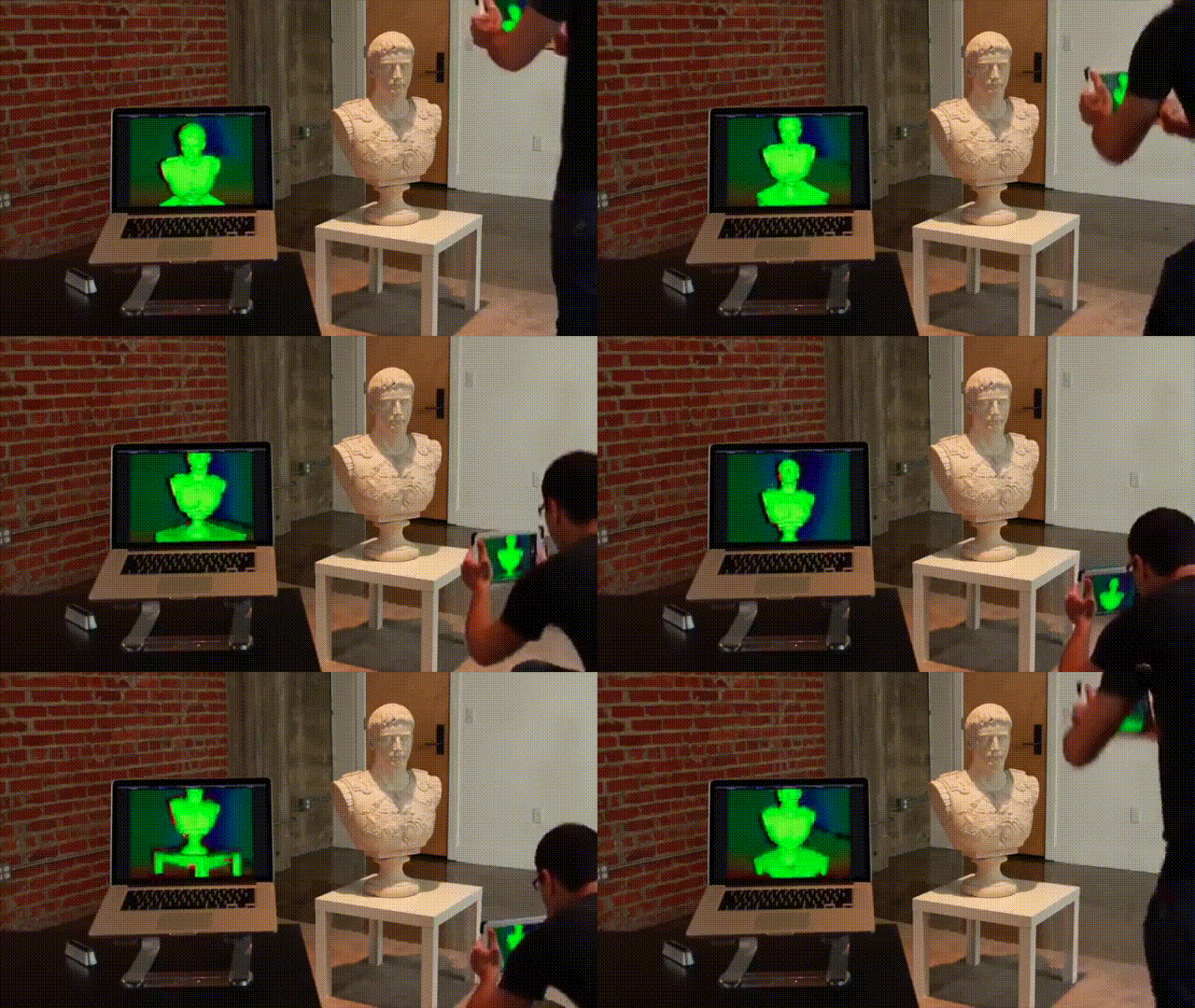
      What it is: Structure is a 3D capture device that plugs into an iPad to create a 3D scan of any physical space or object. While we've seen similar products (e.g. Google's Project Tango), Structure uses commonly available hardware and a lower cost (around $500 for the full developer kit, and the structure sensor is $379).

      Why it's important: We're witnessing a race to the "user interface moment" -- the point in time where an interface emerges that makes it fast and easy enough for amateurs to generate (and earn money with) mixed reality environments and dense 3D models.

      Spotted by Martin Dell

      Microsoft's Testing DNA Storage: 1,000,000,000 TB in 1 Gram

      DNA storage

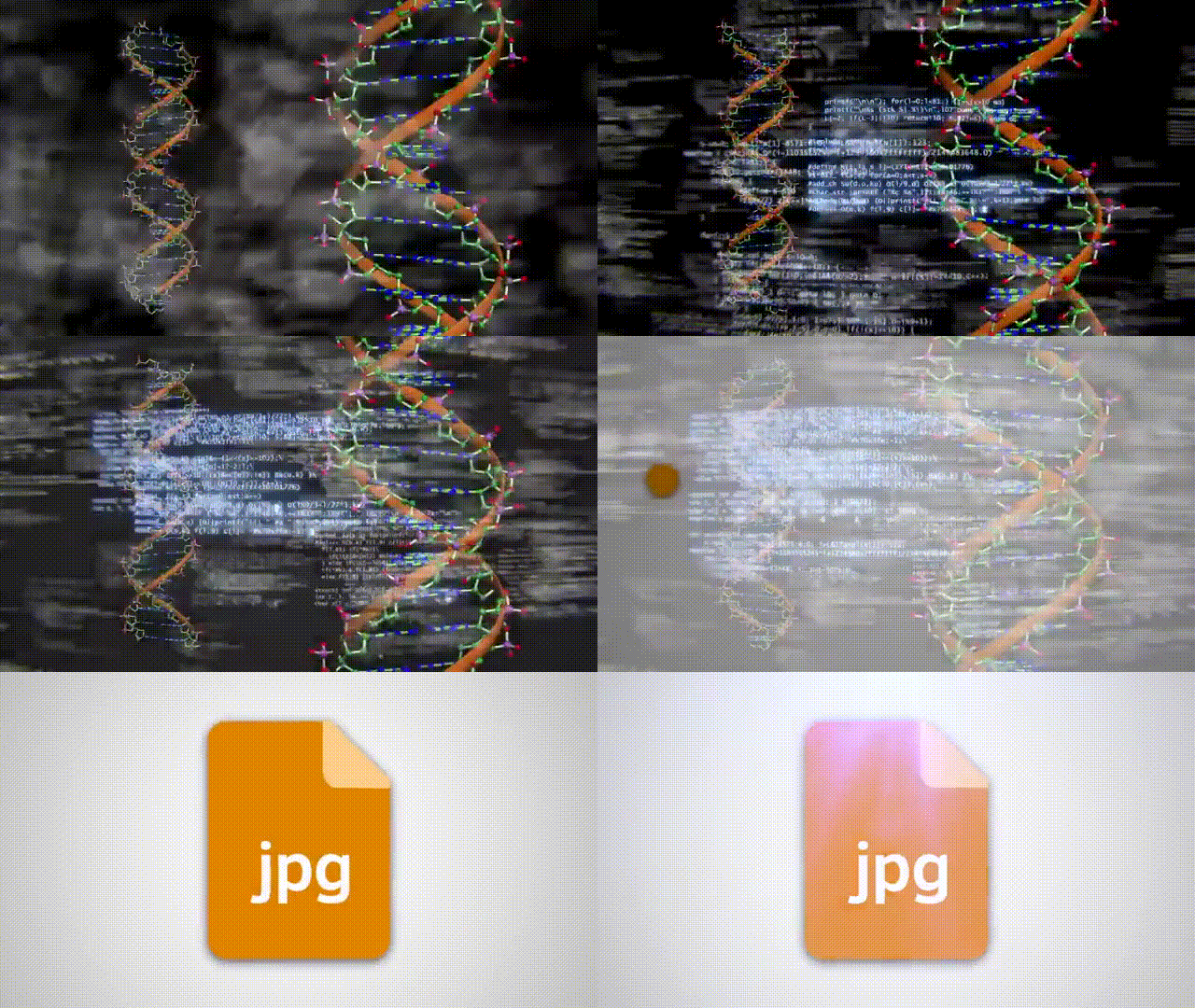
      What it is: Is DNA the next frontier of digital data storage? Microsoft thinks so -- it's just purchased 10 million strands of synthetic DNA from Twist Bioscience for experimentation. Futurism reports that Microsoft's initial tests revealed that they can encode and recover 100 percent of binary data from synthetic DNA. Twist Bioscience uses a semiconductor-based synthetic DNA manufacturing process, which it says offers "unmatched scale and product quality."

      Why it's important: "Today, the vast majority of digital data is stored on media that has a finite shelf life and periodically needs to be re-encoded," explained Twist Bioscience CEO Emily M. Leproust, Ph.D. in a press release. "DNA is a promising storage media, as it has a known shelf life of several thousand years, offers a permanent storage format and can be read for continuously decreasing costs."

      Spotted by Aryadeep S. Acharya

      Scientists Make Seawater Drinkable, Produce 6.3 Million Liters a Day

      desalination sea water india

      What it is: Water may be scarce now, but it won't be for long. Scientists at India's Bhabha Atomic Research Centre (BARC) are using waste steam from a nuclear reactor to desalinate seawater -- and they're already producing 6.3 million liters of purified water per day. BARC's desalination process also includes a purification step that can transform even arsenic- and uranium-tainted water into safe drinking water.

      Why it's important: When we can transform any water source -- no matter how polluted or contaminated -- into potable water, we enable breakthroughs in health, longevity and global transformation. This desalination method, which is already rolled out throughout India, is one step closer to that future.

      Spotted by Marissa Brassfield

      Australian Researchers Develop Breakthrough in Solar Technology

      solar technology breakthrough

      What it is: Researchers at the University of South Wales in Australia have made a major breakthrough: the world's highest efficiency rating for a full-sized, thin-film solar cell. Other thin-film cells are made from toxic materials like cadmium and selenium, or rare materials like indium and tellurium, but the UNSW team used a CZTS cell made of nontoxic, Earth-abundant materials: copper, zinc, tin and sulfur.

      Why it's important: One step closer to thin-film solar cells that are cheap, efficient and safe enough for ubiquitous use in residential, commercial and industrial applications.

      Spotted by Peter Diamandis

      Scientists Accidentally Create a Battery That Can Outlast Your Device

      battery that outlasts your device

      What it is: University of California at Irvine researchers recently developed a battery that can take 200,000 charge cycles -- 400 times the charges that a traditional lithium battery can take. What's even more surprising about this development is that it was entirely by accident. The lab had been working on using gold nanowires instead of lithium to create a solid-state battery, and Ph.D candidate Mya Le Thai had an idea to cost the nanowire with manganese oxide and then suspend it in an electrolyte gel for protection.

      Why it's important: Sometimes the biggest breakthroughs come from non-experts. This single discovery could lead to rechargeable batteries that last forever -- a tremendous leap forward for anything that needs power.

      Spotted by Aryadeep S. Acharya

      Think to Speak' App Technology for People With Impaired Verbal Communication

      smartstones app

      What it is: Smartstones is a platform and accompanying app that turns any sensory IoT device (think EEG headsets) into a communication interface using "thought messages" -- text messages or app-based push messages created solely by thinking them. Using an EEG headset and Smartstones' app (called :prose), anyone -- including those with autism, ALS, deafness, brain injuries or spinal cord injuries -- is able to communicate simply and effectively with the world around them.

      Why it's important: Smartstones is a promising user interface for thought-to-text communication. "Communication is the most important part of the human experience and we want to ensure every person has the ability to express their most basic needs," explains Smartstones CEO Andreas Forsland. "With 2.3 million nonverbal children in the USA with autism alone, and over 70 million on the autism spectrum worldwide, everyone has a unique need when it comes to a communication interface."

      Spotted by Greg O'Brien

      Latest Dubai Bid Represents a Solar Power Price Drop of 50% in 16 Months

      dubai solar bid

      What it is: Electrek reports some fascinating news out of the UAE: Dubai recently received bids for $.0299/kWh for 800MW of solar power, which represents the lowest recorded price for solar power thus far. This article also highlights recent solar energy pricing trends around the world, with extensive forecasting and financial projections.

      Why it's important: Overwhelming evidence that solar energy hasn't stopped its exponential price-performance growth -- and some of the most substantial developments are happening outside of North America and Europe.

      Spotted by Gabriel Delgado Ayau

      SpaceX Lands Its Fastest-Flying Rocket Yet

      spacex rocket gto

      What it is: This week marks another new space milestone, thanks to Elon Musk and his team at SpaceX. Quartz reports: "This is the first time that the company has landed a rocket that flew to 'geosynchronous transfer orbit,' or GTO. That means it set its satellite cargo on a path to reach an altitude where the speed of its orbit will match the speed of Earth's rotation, allowing it to 'hang' over one place, about 36,000 kilometers above us."

      Why it's important: While this SpaceX achievement has tremendous potential for the space industry and interplanetary travel, there's an even more exciting implication for Abundance Insider readers. Quartz's reporting continues: "The most lucrative satellites are those that hang over one spot on earth in their geosynchronous orbits. Introducing reusability into that launch market is key to lowering the price and growing SpaceX's market share. And, at a time when numerous companies are developing cheap solutions to launch satellites in to low-earth orbit, ensuring dominance at the highest of altitudes will insulate SpaceX from those competitors."

      Spotted by Marissa Brassfield

      These Images Illustrate the Future of Autonomous Vehicles

      future of autonomous vehicles honda

      What it is: Honda, Mori Inc and Map have created a concept called "Honda. Great Journey" that shows seven futuristic self-driving transportation concepts. These designs show off how future autonomous cars might navigate tricky terrain like rainforests, cracked ice, deserts and mountains.

      Why it's important: An innovative and visually appealing glimpse into the future of how highly specialized autonomous cars will move us forward. (By the way, this advertorial is also a great example of how big brands can help usher their customers into the future -- and, as a result, earn and/or maintain their trust and loyalty.)

      Spotted by Marissa Brassfield

      What is Abundance Insider?

      This email is a briefing of the week's most compelling, abundance-enabling tech developments, curated by Marissa Brassfield in preparation for Abundance 360. Read more about A360 below.

      Want more conversations like this?

      At Abundance 360, Peter's 250-person executive mastermind, we teach the metatrends, implications and unfair advantages for entrepreneurs enabled by breakthroughs like those featured above. The program is highly selective and we're almost full, but we're still looking for a few final CEOs and entrepreneurs who want to change the world. You can apply here.

      Know someone who would benefit from getting Abundance Insider? Send them to this link to sign up.


      If you wish to stop receiving our emails or change your subscription options, please Manage Your Subscription
      PHD Ventures , 800 Corporate Pointe, Suite 350, Culver City, CA 90230


      Sunday, May 1, 2016

      Fwd: solve big problems & test new ideas in just 5 days


      ---------- Forwarded message ----------
      From: Peter Diamandis <peter@diamandis.com>
      Date: Sunday, May 1, 2016
      Subject: solve big problems & test new ideas in just 5 days
      To: STeve <stevescott@techacq.com>


      <https://blogger.googleusercontent.com/img/proxy/AVvXsEiNGBUvkIN-KPQhXQP1dNMoiEpl3edVtVHUErmyiHo8dzju0R5DDfeOnJAN07QNUNsY5VQ5uGy8gksdn2bVrxkYUAhfhYRLtU3nl4nyzhaeS4iIn9_6TtXwZdqx6cEcXEIonbk8OjKWLPAQPH0OtzY2Dx3wt4dTHiNTS2rDXbm2dr_066LhKGNMmRtF4D700eB9H6KRGe9vHbgAsqxI=s0-d-e1-ft&stn=0&cid=1180&mid=19523920&aid=22289&aaid=2&time=1462122253>

      This blog will teach you the process of running a "design sprint" – a method developed by Jake Knapp, a partner at Google Ventures – to solve big problems and test new ideas in just five days.

      Most teams often invest months, even years, in developing a product or service -- only to discover they've built something that no one wants.

      Jake developed a method that helps teams make better use of time and resources by simulating the entire product development process in just five days.

      A design sprint helps teams filter ideas and gain clarity as to which of them are best to pursue.

      Let's dive in and see what that process looks like at a high level, and how to implement it.

      For more a more detailed, step-by-step process, check out Jake's book.

      Preparing for the Sprint

      To kick-off a design sprint, your goal is to assemble a diverse team from within your company of five to eight experts in different areas of the business.

      Jake notes that the sweet spot here is seven people -- any more will only "create drag."

      An ideal team involves representation from the engineering, sales, customer support and marketing departments, as well as, critically, "the Decision Maker."

      Each person brings a key understanding to the process: engineering understands product capabilities, sales understands customer preferences, customer support sees customer challenges, and marketing holds key insights that tie it all together.

      Over the course of the next five days, the team will develop and test a number of different things. You can run sprints on key features (What should my landing page look like? How should we price it?), product variations (Do people prefer this type of product or something else?), or entirely new businesses (Does this business solve a key problem for a customer? Are they willing to pay for this product?).

      Here's how the five key days play out…

      <https://blogger.googleusercontent.com/img/proxy/AVvXsEhL4JmlPwWaGiZAmWwhmUFKP7STek3tgk-KFMf8J9O628Q1WOm5jsYwSi2V2ufIjt6MOpBJLf8jdlGtt2igi2ZWZO44ng54iJi6H3Dqh-gj1abfCQbEuoNomBaThS4tdaBCrO3SSGxHNS-su2pfMwYyUOqbAngXjVYxsFnfK8bIFeziOnJko1C3VD-LdlLy5MD4=s0-d-e1-ft>

      Day 1: Monday -- Map and Define the Problem

      Day 1 is about defining the problem you want to solve.

      The decisionmaker in the group should facilitate the agreement around a long-term goal. What the company or product should achieve in, say, eight months' time. Make sure everyone is aligned and excited about this goal, write it down and post it on the wall.

      Then, map out a series of difficult questions, potential barriers to achieving that goal:

      What are the technical and market risks?
      What if people don't care about it?
      What if they won't use it?
      What might they not trust?

      After you've mapped out the questions, spend time trying to answer the most important of them based on the information you know.

      Next, brainstorm and list as many different types of customers (demographics) that you believe have the problem you are trying to solve. Now pick one (either the one you best understand or the largest cohort). This is the customer for whom you are going to be (designing) running the design sprint.

      Based on this understanding, one team member is next assigned to recruit five real potential customers who fit these characteristics from outside the company. These five people will be asked to physically show up on Friday to test the product you're designing.

      Why five? Back in the 90s, Jakob Nielsen did a study to answer this question: "How many interviews does it take to spot the most important patterns?"

      It turns out that 85 percent of the problems were observed after just FIVE people reviewed a product!

      Additionally, the deadline of actual customers coming in five days creates an added incentive to have a workable product finished by then.

      The team's last task for Day 1 is to Ask the Experts. Somebody out in the world knows "the most" about your customers; somebody knows the most about the technology, the marketing channels, the business, and so on. Your goal is to find them and pick their brains.

      This is usually where people find the most exciting ideas.

      Day 2: Tuesday -- Create Solutions

      Jake compares ideas in product design to LEGO bricks: they can be combined and recombined in new ways to create something better.

      On Day 2, the team first sketches (literally, on large sticky notes) competitors' solutions and puts them up on the wall for everyone to see.

      Next, each team member sketches new solutions that combine these "LEGO bricks" to address the problem identified on Day 1.

      Each person does their sketching on their own and submits their sketches anonymously. Each member can submit one, two or even three solutions.

      This individual process prevents the groupthink that occurs with traditional brainstorming.

      The goal is for each individual to create fully fleshed out ideas, empowering introverted team members to contribute equally.

      Note: You need to be quite thorough with these sketches -- they should illustrate how the solution would work for the target customer, what the customer sees going through the app or website, and so on… They can be rough, but they should be very detailed and precise.

      Day 3: Wednesday -- Downselect

      Suspense is high coming in on Wednesday morning. The team tapes up sketches and everyone marks their favorite ideas with a dot.

      The team engages in a timed critique of each concept. Interestingly, the person who sketched it isn't allowed to speak until the end. This minimizes bias and ensures the process is truly meritocratic, allowing people to be as honest as possible with their critique.

      In a group of seven sprint participants, there may be anywhere from seven to 15 proposed storyboard solutions.

      The team votes on the solutions they believe in and are most excited about testing.

      The clincher, however, is that The Decision Maker casts "super-votes," which supersede all other votes, choosing up to three solutions to test fully on Friday. Ideally, though, you pick the best single prototype to answer the question you defined at the beginning of the week.

      Next, create a storyboard. The team should flesh out the top idea(s), detailing everything from discovery (i.e. how a user comes across the product for the first time -- for example, on a store shelf, via a web search or news article) to every other part of the user experience.

      In other words, this storyboard needs to be able to stand alone without a verbal explanation, so it may be evaluated in an unbiased manner, on their merits alone, not based on who created the storyboard.

      The next step is to take the idea beyond the storyboard and transform it into a high-resolution mockup that looks and feels like an actual product.

      Day 4: Thursday -- Put It All Together & Build the Mockup

      Once the team has an idea of how everything will look and feel, they assign tasks to different team members to build a prototype.

      A good rule of thumb is: Build just enough to learn, but not more...

      These prototypes don't have to be fully functional, but they should look like they are. Buttons might not fully work, but when pressed should drive the customer down a different path…

      Jake calls this "Goldilocks Quality" – the prototype should have just enough quality to evoke honest reactions from customers.

      After team members build their mockup, the team regroups to connect the pieces and flesh out the full experience they want to put their five clients through tomorrow. They need to assure everything appears realistic and cohesive.

      Day 5: Friday -- Observe Customer Reactions (and Learn!)

      Day 5 is when the real fun begins – you get detailed and authentic feedback from real customers.

      The five people you recruited on Day 1 have shown up to test the product/prototype.

      It's best to bring them in face-to-face to test the product in person if possible, though videoconferencing can suffice in some cases.

      Identify "The Interviewer" on your team – this person will interact one-on-one with your customer, who is testing the product.

      The rest of your design team observes customer reactions via live video in a separate room.

      The Interviewer asks the customer different questions (you should write a script):

      What do you think about what just happened?
      How would you compare the different options?
      What worked?
      What didn't?
      Would you buy this?

      CRITICALLY -- The team observes customer reactions, rather than listens to feedback.

      This ensures that the insights they glean are as honest as possible.

      By the end of this observation, you should be able to see patterns.

      You'll know what's working well and resonating, and what's confusing and what people don't care about.

      These insights answer some of the larger questions posed at the beginning of the sprint and inform the direction that the team will head in next.

      This knowledge is extremely valuable and gathering it now will save you an incredible amount of time and money later.

      What does this mean for you?

      Design sprints are an essential tool that entrepreneurs can use to fail fast, rapidly iterate and grow quickly.

      For me it's part of my year-long exploration of how to best 'experiment' in building my businesses, products and services.

      Working in a group environment successfully is difficult and, as Jake mentioned, A crucial, but overlooked, part of the design process is designing the way in which we work together.

      The structured design sprint process enables teams to operate in ways that are effective in gleaning real, actionable insights about what works and what doesn't.

      It empowers individuals with crazy ideas and also squashes ideas that aren't validated by customers.

      If your team is grappling with whether to launch a new feature or product, it's worth giving a design sprint a try.

      You'll be amazed by the results.

      Join Me

      This is the sort of conversation we explore at my 250-person executive mastermind group called Abundance 360.

      The program is highly selective. If you'd like to be considered, apply here.

      Share this with your friends, especially if they are interested in any of the areas outlined above.

      This blog is part of a series I am doing on "Hiring, Culture, and Experimentation". If you have questions or comments about these topics, tweet at me @peterdiamandis and @codyrapp, and we'll incorporate them into our research.

      P.S. Every week I send out a "Tech Blog" like this one. If you want to sign up, go to Diamandis.com and sign up for this and Abundance Insider.

      P.P.S. My dear friend Dan Sullivan and I have a podcast called Exponential Wisdom. Our conversations focus on the exponential technologies creating abundance, the human-technology collaboration, and entrepreneurship. Head here to listen and subscribe: a360.com/podcast

      If you wish to stop receiving our emails or change your subscription options, please Manage Your Subscription
      PHD Ventures , 800 Corporate Pointe, Suite 350, Culver City, CA 90230
      <https://blogger.googleusercontent.com/img/proxy/AVvXsEiZOt5u9PJk0Oeo8aRiPKQ27fWMWYFlXeGi7ADmpGdFmDX5U3-rCtR6xFZh0aMtGXL7yz5TLRs6eGJ3mB9__r4Ica6MovTLUxuT3UCDA3Y1BPZ6NC40EqluT_f8PLDHRzQ4hJP32GXjVci1943minNV4B4rZDPcgsdyNwzqkA=s0-d-e1-ft>

      Friday, April 29, 2016

      Fwd: Abundance Insider: April 29 Edition


      In this week's Abundance Insider: Flying taxis, brain-controlled drone racing and printer ink made from pollution.

      Cheers,
      Peter, Marissa, Cody, Maxx, Kelley and Greg

      P.S. Send any tips to data@diamandis.com, and send your friends and family to this link to subscribe to Abundance Insider.

      Taxis to Take Flight

      flying taxis

      What it is: The e-volo Volocopter VC200 is the world's first certified multicopter -- and it just received its permit to fly as an ultralight aircraft in Germany. The electric personal aerial vehicle takes off and lands vertically using a simple joystick control, and e-volo boasts that its design is easy enough for anyone to pilot it. The company's next goals are to initiate air taxi services, enter the air sports market, and continue its autonomous mobility development.

      Why it's important: As autonomous vehicle technology continues to improve, futuristic transportation methods like this one may become a cheaper, easier and faster mode of travel than even self-driving taxis on the ground. Expect to see even more innovative approaches when the Transporter XPRIZE launches.

      Spotted by Ryan Wolfred

      World's First Brain-Controlled Drone Race

      brain controlled drone race

      What it is: Drone racing is gaining widespread popularity, and the University of Florida broke new ground in this niche with the first-ever brain-controlled drone race. Sixteen pilots used BCI software, electroencephalogram headsets and their focused thoughts to send drones down a 10-yard indoor course.

      Why it's important: Another early demonstration of BCI advancements. It won't be long until we can interact with objects around us -- in our homes, at work and everywhere else -- just using our thoughts. Talk about magic!

      Spotted by Keith Gargiulo

      Printer Ink From Pollution

      printer ink from pollution

      What it is: What if the black carbon found in air pollution could be transformed into industrial paint? That's exactly what Sbalabs is doing with Kaalink: "repurposing pollution's carbon capture to industrial-grade raw material for [the] printing industry (inks, pigments, paints, etc).

      Why it's important: With aftereffects like premature death, bronchitis, heart attacks and aggravated asthma, air pollution is definitely a billion-person problem. This process takes carbon out of the air and turns it into a raw material with thousands of industrial applications -- now that's turning scarcity into abundance!

      Spotted by Rajat Gupta

      Artificial Intelligence Now Fits in a USB Stick

      artificial intelligence usb stick

      What it is: Modivius, whose chips power everything from FLIR cameras to DJI drones, has announced the Fathom Neural Compute Stick, a USB drive that enables users to rapidly prototype neural networks. "Fathom contains the Myriad 2 MA2450 VPU paired with 512MB of LPDDR3 RAM," Engadget explains. "The Myriad 2 is the chip found in the previously mentioned DJI and FLIR products... [and] can handle up to 150 gigaFLOPS (150 billion floating-operations per second) while consuming no more than 1.2 watts."

      Why it's important: An impressive dematerialization and demonetization of neural networking capabilities. It has the form factor of a normal thumb drive, but Engadget writes that using just this USB drive and a Raspberry Pi, any user can add "advanced computer vision capabilities to something like a GoPro."

      Spotted by Marissa Brassfield

      SignAloud Gloves Translate Sign Language

      signaloud gloves

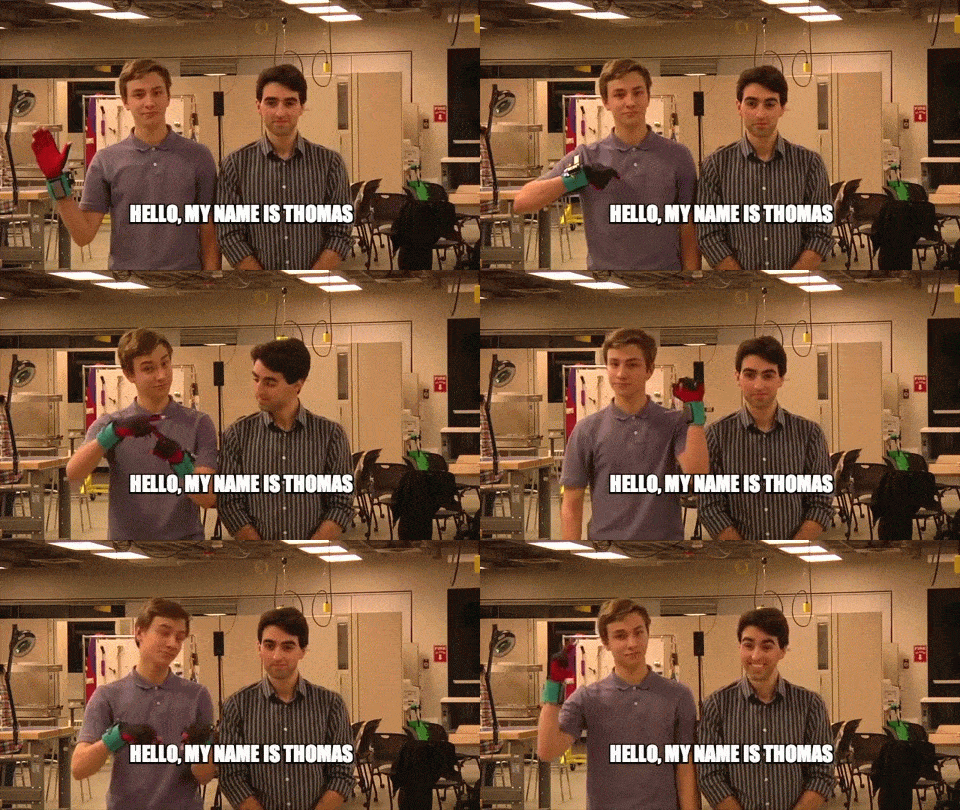
      What it is: University of Washington students Navid Azodi and Thomas Pryor have developed SignAloud gloves, a set of gloves with the power to translate American Sign Language into text or speech. The glove's sensors record movement and transmit gesture data wirelessly to a central computer, which then parses the data and dictates all recognized gestures through a speaker.

      Why it's important: How do you think about your customer base when you no longer have language barriers? These lightweight, inconspicuous gloves let sales representatives, customer service agents and teachers communicate with ASL speakers in a natural, seamless way.

      Spotted by Greg O'Brien

      How Cheap Can Electric Cars Get?

      electric cars

      What it is: Futurist Ramez Naam has analyzed how cheap electric cars can get, and his predictions are exciting: by 2030, electric vehicles with a 200-mile range will be cheaper than the least expensive car sold in the U.S. in 2015. Naam backs up his claim by citing enabling factors like improvement in batteries and production efficiency increases.

      Why it's important: As the materials and technologies behind renewable energy continue to improve, prices will continue to plummet -- which will only accelerate their adoption.

      Spotted by Marissa Brassfield

      Machine Learning Rivals Human Skills in Cancer Detection

      machine learning cancer recognition

      What it is: KurzweilAI.net reported two key developments that suggest deep learning algorithms are just as effective as humans at detecting cancer from ultrasound images and in identifying cancer in pathology reports. The first was the development of Samsung Medison's RS80A ultrasound imaging system, which features a built-in deep learning algorithm for breast lesion analysis. The second was a study out of the Regenstreif Institute that found open-source machine learning tools to be as good or better than humans at "extracting crucial meaning from free-text (unstructured) pathology reports and detecting cancer cases."

      Why it's important: Shaun Grannis, M.D. describes the importance perfectly: "We have come to the point in time that technology can handle this. A human's time is better spent helping other humans by providing them with better clinical care. Everything -- physician practices, health care systems, health information exchanges, insurers, as well as public health departments -- are awash in oceans of data. How can we hope to make sense of this deluge of data? Humans can't do it -- but computers can."

      Spotted by Marissa Brassfield

      The Playboy Interview With Ray Kurzweil

      ray kurzweil

      What it is: Ray Kurzweil's Playboy interview went live this week, in which he illustrates several future scenarios in depth. Topics include the future of sex, the future of education, nanobots in our bloodstream, and how humans are merging with nonbiological technologies.

      Why it's important: Ray's lifetime predictions about the future are accurate over 80 percent of the time, so anytime you have a chance to hear or read one, take note. Tracking technology's progress and making proactive business decisions are essential skills in this exponentially growing world.

      Spotted by Peter Diamandis

      Musk: Tesla's Autopilot is 50 Percent Better at Avoiding Accidents Than You Are

      tesla autopilot safety

      What it is: Elon Musk recently made a bold safety claim about Tesla's Autopilot function: "The probability of having an accident is 50 percent lower if you have Autopilot on. Even with our first version. So we can see basically what's the average number of kilometers to an accident -- accident defined by airbag deployment. Even with this early version, it's almost twice as good as a person."

      Why it's important: One more piece of evidence that autonomous cars will be significantly safer and more efficient than human-driven cars.

      Spotted by Marissa Brassfield

      What is Abundance Insider?

      This email is a briefing of the week's most compelling, abundance-enabling tech developments, curated by Marissa Brassfield in preparation for Abundance 360. Read more about A360 below.

      Want more conversations like this?

      At Abundance 360, Peter's 250-person executive mastermind, we teach the metatrends, implications and unfair advantages for entrepreneurs enabled by breakthroughs like those featured above. The program is highly selective and we're almost full, but we're still looking for a few final CEOs and entrepreneurs who want to change the world. You can apply here.

      Know someone who would benefit from getting Abundance Insider? Send them to this link to sign up.


      If you wish to stop receiving our emails or change your subscription options, please Manage Your Subscription
      PHD Ventures , 800 Corporate Pointe, Suite 350, Culver City, CA 90230


      Sunday, April 24, 2016

      Fwd: how X (Google) experiments


      This blog explores how to run great experiments in your company, based on recent conversations with my friend Astro Teller, Chief of Moonshots at "X" (formally Google X, Google's R&D factory).

      X's mission is to invent and launch "moonshot" technologies that could make the world a radically better place… dare I say, help create a world of Abundance.

      Astro leads a team of brilliant engineers, scientists and creatives developing solutions to dozens (perhaps hundreds) of the world's toughest problems. Some of their publicly known projects include: the self-driving cars, the smart contact lens, high-altitude wind-power generation, and Project Loon, just to name a small fraction.

      All of these projects started as a series of experiments.

      Today's most successful companies, the ones that are "crushing it," started as a series of crazy ideas, followed by experiments to test just how viable those ideas might be.

      Experimentation is a crucial mechanism for driving breakthroughs in any organization.

      BTW, you may also want to check out Astro's 2016 TED talk which was just released: The Unexpected Benefit of Celebrating Failure.

      What Are Experiments and Why Do They Matter?

      Experiments help you test a hypothesis about your product or service and help you find answers to your most difficult questions.

      Good questions are questions that, if answered, fundamentally change (and improve) the way you operate.

      Understanding how to focus your team on asking good questions and turning good questions into experiments is critical. 

      So what makes a good experiment?

      The Three Principles of a Good Experiment

      Astro explains that the following three principles describe a good experiment:

      Principle 1: Any experiment where you already know the outcome is a BAD experiment.

      Principle 2: Any experiment when the outcome will not change what you are doing is also a BAD experiment.

      Principle 3: Everything else (especially where the input and output is quantifiable (i.e. measurable)) is a GOOD experiment.

      Seems simple enough, right?

      You need to be asking questions to which you don't know the answer but such that if you did know the answer, you'd change the way you operate.

      If you already know the answer, or if you are testing an insignificant detail that doesn't matter, you'll just be wasting time and money.

      How to Ask Good Questions and Design Good Experiments

      In any organization, you get what you incentivize.

      In order to get good questions/experiments, you have to create a culture that incentivizes asking good questions and designing good experiments.

      Astro describes a very unique approach to doing just this:

      "At X, we set up a 'Get Weirder Award'. The whole point of the Get Weirder Award was to focus the team on experiments and to drive home why they needed to think in terms of experiments."

      Teams would be challenged to ask "weird" questions – to put forth crazy ideas around framing problems differently and to design experiments that really push the limits.

      Critically, Astro gives out the Get Weirder Award before the experiments are run.

      "If you give out the award before you've run the experiment, then people start to really feel that you don't actually care about the outcome. You care about the quality of the question. So every two weeks, we would give out an award for the best experiment."

      Doing so constantly (and viscerally) reinforced the behavior of asking good questions – and as such, at X, they've built a culture around celebrating the questions themselves.

      How to Manage Experiments

      Once you've designed a good experiment and assembled an intellectually diverse team to tackle it, what are the best management principles to keep from screwing it up?

      Management Principle 1: Don't Be a Bottleneck!

      As a CEO or manager, it is critically important that you don't get in your team's way by micromanaging them or by demanding to be the sole decision maker.

      If you need all of the information, all of the time, your team will never get their work done.

      Astro explains, "Your job as a manager is to give your team your recommendations and empower them to do whatever they think is right.  Allow them to learn."

      He continues, "I work super hard for me not to be the bottleneck at anything that goes on here. Ironically, that's a full-time job."

      One funny story involved two employees who had a major strategic conflict.  They wanted Astro to make a decision as to which one was right.

      Rather than do so, he said, "I believe I already know which of you is right and which of you is wrong. I can just make that decision right now, but I'm not going to. The problem is: if I tell the two of you who's right and who's wrong, in my opinion, the next time you have conflict, you will come back and ask me to do it again, and that does not scale. I will spend however as much time it takes to either train the two of you to work well together or figure out that you can't."

      Not being a bottleneck means deliberately letting your team learn. Sometimes it's hard to do, but it's a necessary step if you want to derive the most value from your experiments.

      Management Principle 2: The Value of Secrecy

      In a previous blog, I mentioned the notion that ambitious entrepreneurs (and companies) need to get comfortable with being misunderstood.

      Interestingly, experiments are one of the most publicly misunderstood domains within a company.

      We talked in great depth in the last blog about why you have to focus on killing your ideas –in line with that discussion, an experiment that proves an idea won't work is as successful of an experiment as proving that one will work!

      The problem is: the public (and especially the press) doesn't understand this.

      They see "failed experiments" and think, "failed company" – which adds enormous pressure and stress to your employees and investors.

      Thus, it can be useful to keep your experiments secret.

      Astro explains, "The main value of secrecy is not 'to hide our awesome ideas', it's to make it easier to kill ideas. Secrecy offers air cover. It allows the team to have the emotional space to solve the problems without outside pressure."

      Management Principle 3: Don't Worry about Success -- Worry about Progress & Learning

      Finally, if you are worrying about success, you are going to be paying attention to all of the wrong indicators and misguiding your team.

      You need to focus on progress and learning – and success will follow.

      Rather than creating a culture that only celebrates big wins, create one that celebrates progress on tough projects and running good experiments.

      You'll be amazed by the difference in your organization with such a small mindset and cultural shift.

      Join Me

      This is the sort of conversation we explore at my 250-person executive mastermind group called Abundance 360.

      The program is highly selective. If you'd like to be considered, apply here.

      Share this with your friends, especially if they are interested in any of the areas outlined above.

      This blog is part of a series I am doing on "Hiring, Culture, and Experimentation". If you have questions or comments about these topics, tweet at me @peterdiamandis and @codyrapp, and we'll incorporate them into our research.

      P.S. Every week I send out a "Tech Blog" like this one. If you want to sign up, go to Diamandis.com and sign up for this and Abundance Insider.

      P.P.S. I've just released a podcast with my dear friend Dan Sullivan called Exponential Wisdom. Our conversations focus on the exponential technologies creating abundance, the human-technology collaboration, and entrepreneurship. Head here to listen and subscribe: a360.com/podcast


      If you wish to stop receiving our emails or change your subscription options, please Manage Your Subscription
      PHD Ventures , 800 Corporate Pointe, Suite 350, Culver City, CA 90230


      Avast logo

      This email has been checked for viruses by Avast antivirus software.
      www.avast.com