Friday, April 22, 2016

Fwd: Abundance Insider: April 22 Edition


In this week's Abundance Insider: 3D printing stem cells in real time, origami-inspired metamaterials, and bacteria-powered solar panels.

Cheers,
Peter, Marissa, Cody, Maxx, Kelley and Greg

P.S. Send any tips to data@diamandis.com, and send your friends and family to this link to subscribe to Abundance Insider.

Virtual Art Sessions Let You Experience Fine Art in Your Browser

Virtual Art Session

What it is: A new initiative from Google Chrome called Virtual Art Sessions brings fine art -- and its creation -- to life. Using the Google Chrome browser, users can observe six famous artists as they use the Tilt Brush app to create new works in virtual reality from start to finish, with views from any angle, including the artist's perspective.

Why it's important: This intimate look into artists' creative process is enabled -- and significantly enhanced, at least for the viewer -- thanks to virtual reality. By digitizing, dematerializing and demonetizing fine art, the Google Chrome team will also democratize its access to people around the world.

Spotted by Alan Livshin

3D Printing BioPen Lets Surgeons Draw With Stem Cells
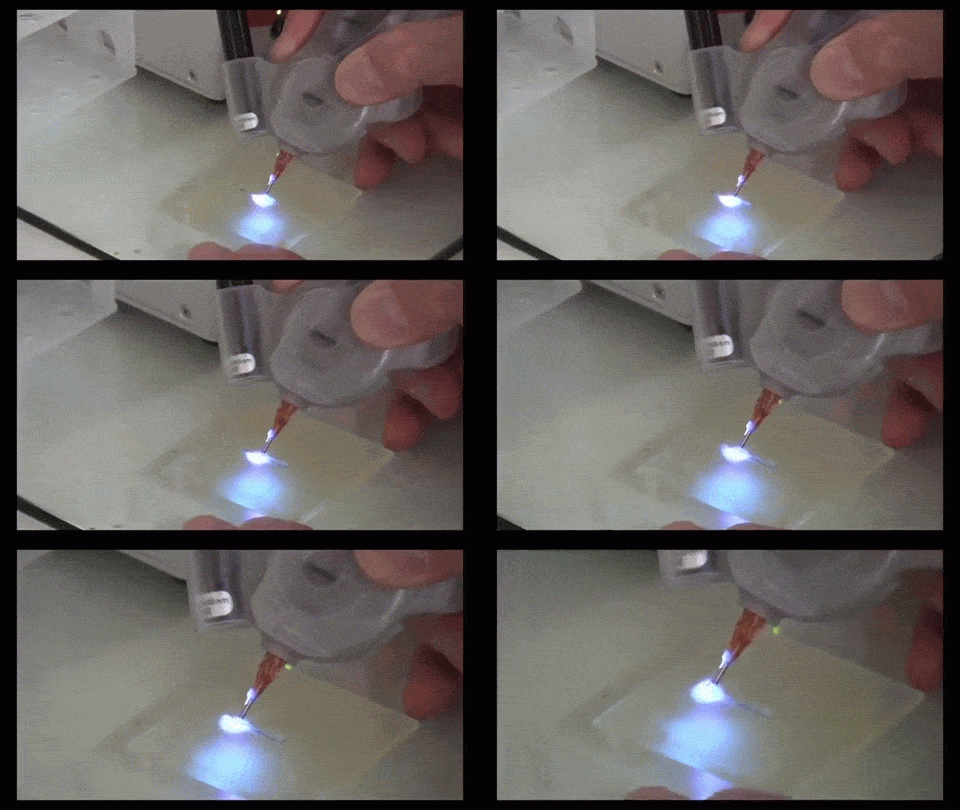
BioPen

What it is: The BioPen is a 3D printing device that enables surgeons to perform "in-situ biofabrication" -- which, as Mashable describes, is "the ability to effectively print viable human stem cells into damaged joints to regrow cartilage." The BioPen lets surgeons sculpt the material in real time as they draw -- enabling them to precisely place stem cells in challenging areas like crevices or beneath existing tissue. The BioPen was developed by Peter Choong at Melbourne's St. Vincent's Hospital and Gordon Wallace at the Australian Research Council's Center of Excellence for Electromaterials Science (ACES).

Why it's important: This is a powerful breakthrough for orthopedic surgery -- and one more example of how 3D printing can revolutionize and enable truly personalized healthcare. The most exciting aspect of the BioPen, however, may be its price: ACES director Gordon Wallace revealed to Mashable that the cost of assembling the hardware is around $10,000.

Spotted by Keith Gargiulo

Generation Beyond Prepares America's Students for Deep Space Exploration

Learning about Deep Space            Exploration

What it is: Generation Beyond is an emerging national educational program from Lockheed Martin with the goal to bring science and space to life using technology and ultimately get a new generation of school-aged children interested in space exploration. The Lockheed Martin Mars Experience Bus -- an immersive virtual reality vehicle that replicates 200 square miles of the Martian surface -- is one core piece of the curriculum, and there's also a companion app called HelloMars.

Why it's important: The Mars Experience Bus alone has been hailed as a real-life version of the beloved "The Magic School Bus" books and television programs. Virtual reality enables us to create experiences that are intensely immersive, lifelike and entertaining. Why not apply this capability to education?

Spotted by Cody Rapp

Netherlands Looks to Ban All Gas, Diesel Car Sales by 2025

Gas Car

What it is: Dutch politicians are hoping to pass legislation that would ban the sale of any vehicle that emits emissions as soon as 2025 -- including efficient hybrids and plug-in hybrids. It's the latest, most aggressive effort in the Netherlands to increase the country's percentage of renewable energy. "The lower house of the Dutch parliament recently supported the motion put forward by the Labour PvdA party," the Globe and Mail reports. "The cabinet must now come up with a plan to implement the proposal."

Why it's important: Peter often discusses the benefits of constraints on innovation. While critics of this proposed legislation dismiss it as "overambitious and unrealistic," it may actually incentivize tremendous breakthroughs in clean power, autonomous vehicles and eco-friendly transportation.

Spotted by Gaetan Soltesz

Origami-Inspired Metamaterial Eyed for Robots, Space Station

Origami Metamaterials

What it is: Harvard University engineers and scientists have created a shape-shifting metamaterial with tremendous promise for robots or space structures. Inspired by snapology (modular, unit-based origami), the researchers developed a transformable material with three degrees of freedom -- meaning, as Design News describes, "it can be actively deformed into multiple, specific, three-dimensional shapes through embedded actuation." Thermal, water and dielectric actuators can all be embedded in the material.

Why it's important: "This research demonstrates a new class of foldable materials that is also completely scalable," said graduate student Johannes T. B. Overvelde, lead author of the article, in a press release. "It works from the nanoscale to the meter-scale and could be used to make anything from surgical stents to portable pop-up domes for disaster relief."

Spotted by Shaun Arora

USPS's Digital Mail Program Will Go Nationwide in 2017

USPS Digital Mail

What it is: The U.S. Postal Service has just announced Informed Delivery (ID), a free app that sends users digitized previews of the day's mail. Currently, Informed Delivery shows photos of each envelope; by 2017, full-color cameras will be able to capture images and deliver interactive marketing pieces.

Why it's important: This digitization of physical mail has interesting implications on the direct mail industry. For example, imagine if Informed Delivery becomes a frontend for Amazon and similar ecommerce sites by packaging the day's delivery of mail previews with a digital catalog populated contextually.

Spotted by Stafford "Doc" Williamson

Researchers Generate Clean Energy Using Bacteria-Powered Solar Panel

Bacteria powered solar panel

What it is: Researchers at Binghamton University's Thomas J. Watson School of Engineering and Applied Science have created a bacteria-powered solar panel that connects biological-solar cells into a bio-solar panel. This panel, the first of its kind, generated more wattage than any other small-scale bio-solar cells in existence in recent tests.

Why it's important: Creating fuel from abundant sources like bacteria -- specifically, cyanobacteria, which is found in nearly every habitat on Earth -- is an especially promising path to clean, renewable energy.

Spotted by Aryadeep S. Acharya

FemtoSats Are Tiny New Satellites That Could Democratize Space

FemoStats

What it is: We've covered the CubeSat satellites in previous Insider issues, and a team at Arizona State University has created a new iteration called FemtoSat that's cheaper, smaller and lighter than previous generations. Sending a single FemtoSat into lower Earth orbit will set you back $3,000 and $1,000 to send to the International Space Station.

Why it's important: We're witnessing the demonetization of spacecraft development and the democratization of space research. "By reducing the launch cost, it is hoped a wider community of educators, researchers, and hobbyists can develop their own spacecraft," said the ASU researchers.

Spotted by Clyde R. Dennis

Solar Panel Produces Hydrogen Gas

Solar Panel that Produces            Hydrogen

What it is: A team of Belgian bioscience engineers has developed a tiny solar panel that transforms sunlight and water vapor from the air into hydrogen gas. The all-in-one, carbon-neutral system doesn't use a drop of water -- only sunlight and air -- to produce hydrogen. "Chemistry is often frowned upon as a polluting industry, but for a challenge such as climate change, it may very well provide the ultimate solution," explains Johan Martens of the KU Leuven Centre for Surface Chemistry and Catalysis.

Why it's important: This solar cell's small footprint -- and its all-in-one system -- make it especially promising for use in developing countries or remote areas like the middle of the desert. But it isn't just for the developing world: imagine a hydrogen-powered autonomous car that can generate its own fuel using rooftop solar panels.

Spotted by Koen Lenssens

What is Abundance Insider?

This email is a briefing of the week's most compelling, abundance-enabling tech developments, curated by Marissa Brassfield in preparation for Abundance 360. Read more about A360 below.

Want more conversations like this?

At Abundance 360, Peter's 250-person executive mastermind, we teach the metatrends, implications and unfair advantages for entrepreneurs enabled by breakthroughs like those featured above. The program is highly selective and we're almost full, but we're still looking for a few final CEOs and entrepreneurs who want to change the world. You can apply here.

Know someone who would benefit from getting Abundance Insider? Send them to this link to sign up.


If you wish to stop receiving our emails or change your subscription options, please Manage Your Subscription
PHD Ventures , 800 Corporate Pointe, Suite 350, Culver City, CA 90230


Avast logo

This email has been checked for viruses by Avast antivirus software.
www.avast.com


Friday, April 15, 2016

Fwd: Abundance Insider: April 15 Edition


In this week's Abundance Insider: Synthetic skin that sweats, smartphone 3D printers, and sensor-packed fake eggs.

Cheers,
Peter, Marissa, Cody, Maxx, Kelley and Greg

P.S. Send any tips to data@diamandis.com, and send your friends and family to this link to subscribe to Abundance Insider.

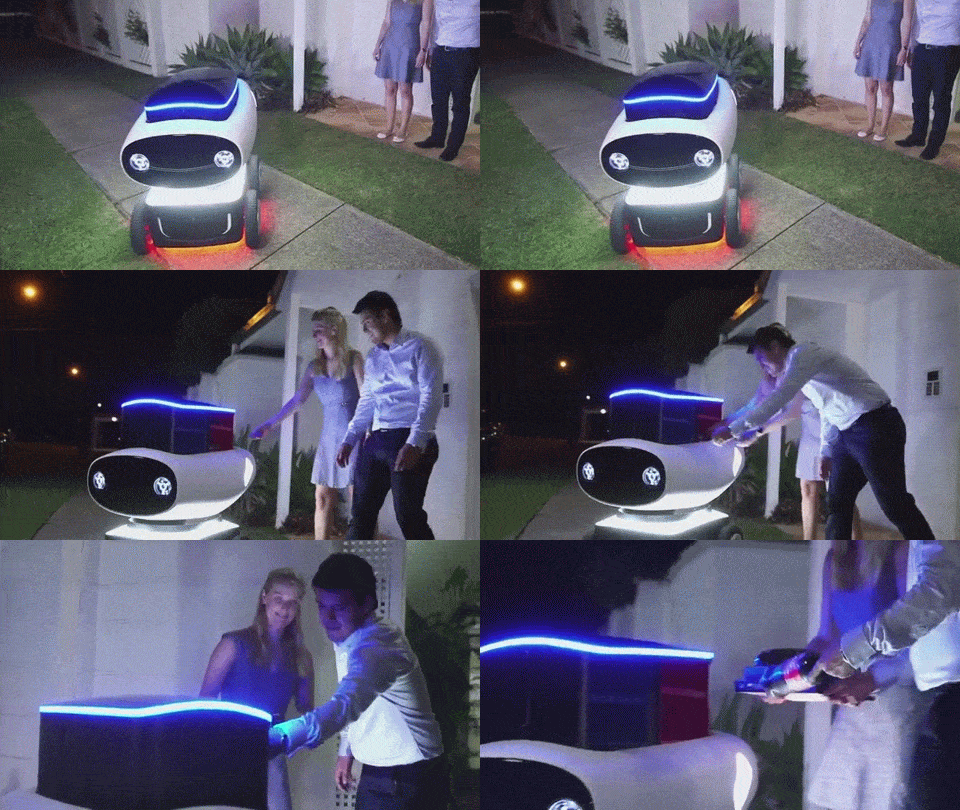
Domino's is Trialling an Autonomous Delivery Robot

dominos autonomous delivery robot

What it is: Domino's recently announced a new autonomous robot called the Domino's Robotic Unit, or DRU, that can deliver pizzas within a 12-mile range. DRU is a little over three feet tall and can carry up to 10 pizza boxes (and many cold beverages) in its dual insulated compartments. Its onboard sensors help it avoid obstacles, and it's built to navigate roads and sidewalks with ease.

Why it's important: This Domino's development is effectively the digitization of delivery drivers. Soon, delivery bots will be as commonplace as the car-top pizza delivery signs we see on the road today.

Spotted by Cody Rapp

Scientists Develop 'Transparent Wood'

transparent wood

What it is: Researchers at the KTH Royal Institute of Technology in Sweden have developed a transparent material based on wood that could revolutionize how we create solar cells and windows. The researchers first removed lignin from wood fibers, leaving the wood pure white, and then mixed it with prepolymerized methyl methacrylate (PMMA), transforming it into its transparent state.

Why it's important: This material has a number of properties that make it ideal for construction purposes: toughness, low thermal conductivity, strength and low density. Eventually, it could replace silica-based glass in windows and solar cells.

Spotted by Aryadeep S. Acharya

Tokyo 2020: The Olympics of the Future

2020 tokyo olympics technology

What it is: We still have four years to go until the Tokyo Olympics, but local organizers have already teased some of the innovations they plan to bring to the global stage. Among them are a robot village filled with cutting-edge automatons that can help people with transportation, directions and translations; instant language translation; autonomous taxis; 8K TV broadcasts; and artificial meteor showers for the opening festivities.

Why it's important: Historically, the Olympics is when cities show off their innovation, and Tokyo 2020 is no exception. (Remember in 2002, when the Salt Lake City Winter Games debuted instant video replays?) It'll be interesting to see which of these "leaked experiences" are commonplace by 2020, thanks to exponential growth.

Spotted by Cody Rapp

First-Ever 3D Printed Robots Made of Both Solids and Liquids

3d printd robots solids liquids

What it is: Researchers at MIT CSAIL have created a new technique that paves the way for 3D printed dynamic robots that are ready for use immediately after printing -- no assembly or cleaning required. The inkjet printing technique enables simultaneous printing of solid and liquid materials, or "printable hydraulics."

Why it's important: "It's an important step towards the next big phase of 3-D printing -- moving from printing passive parts to printing active integrated systems," explains Hod Lipson, a professor of engineering at Columbia University. This capability has massive implications for disaster relief: imagine being able to print a complex, hydraulically powered robot that's ready to go to work immediately.

Spotted by Sarah Black

A Fleet of Trucks Just Drove Themselves Across Europe

autonomous truck fleet european truck platooning challenge

What it is: A tiny fleet (about a dozen) of commercial trucks has just crossed Europe using primarily autonomous driving modes -- the first feat of its kind on the continent. It's all part of the European Truck Platooning Challenge, an elaborate event organized by the Dutch government that hopes to unify the automotive industry and accelerate autonomous commercial trucks.

Why it's important: "Platooning," or the act of autonomous vehicles following each other, has tremendous effects on efficiency: it's cheaper than driving on cruise control, and according to Quartz's reporting of a TNO study, it can also "reduce fuel use by up to 15%, prevent human error from causing accidents, and reduce congestion."

Spotted by Dan Swift

NVIDIA Launches World's First Deep Learning Supercomputer

nvidia deep learning supercomputer

What it is: The NVIDIA DGX-1 is a supercomputer that's designed especially for deep learning. The "turnkey system" has GPU accelerators that can deliver the equivalent throughput of 250 x86 servers, plus an array of deep learning software, development tools and hardware. All together, the system can deliver "12X faster training than four-way NVIDIA Maxwell architecture-based solutions from just one year ago," according to a NVIDIA press release.

Why it's important: "Artificial intelligence is the most far-reaching technological advancement in our lifetime," said Jen-Hsun Huang, CEO and co-founder of NVIDIA. "It changes every industry, every company, everything. It will open up markets to benefit everyone. Data scientists and AI researchers today spend far too much time on home-brewed high performance computing solutions. The DGX-1 is easy to deploy and was created for one purpose: to unlock the powers of superhuman capabilities and apply them to problems that were once unsolvable."

Spotted by Tyler Achtem

Breakthrough Starshot: Yuri Milner & Stephen Hawking's Next Moonshot

breakthrough starshot

What it is: Last year, we covered Yuri Milner's $100 million Breakthrough Listen initiative to search for extraterrestrial life, but the Russian billionaire isn't done. He, along with Stephen Hawking, announced a new project called Breakthrough Starshot, which will "explore the technologies needed to create small, light-powered spacecraft capable of reaching Alpha Centauri in just 20 years," as The Verge reports. Mark Zuckerberg is on Starshot's board of directors, and former NASA AMES director Pete Worden will lead the project.

Why it's important: Besides the prospect of space exploration, this project has a tremendous development potential for business. Chip-sized spacecrafts, like the ones Breakthrough Starshot plans to develop to get to Alpha Centauri, could also be used to deliver free global wifi or gather extensive data on the Earth's surface (crops, water, and more).

Spotted by Arun Gupta

Facebook Unveils 'Surround 360' Open Source Camera

facebook surround 360

What it is: At F8, Facebook revealed a durable, super-portable, 17-lens 3D VR camera called the Surround 360 that's specifically designed to capture high-resolution footage (up to 8K) while dramatically simplifying and optimizing post-production work. What's more, according to TechCrunch, Facebook will open source the hardware designs and video stitching algorithm on GitHub.

Why it's important: By building a world-class camera and then open-sourcing every bit of its design, Facebook is positioned to dramatically accelerate the pace of VR and 360 adoption and content creation.

Spotted by Cody Rapp

Reverse Photosynthesis: Energy Source of the Future?

reverse photosynthesis

What it is: University of Copenhagen researchers have recently announced a breakthrough discovery: reverse photosynthesis. In contrast to photosynthesis (solar rays building plant material), reverse photosynthesis means the energy in solar rays breaks down -- and when combined with natural enzymes called monooxygenases, solar rays can be used to produce biofuels and chemicals for plastics in an incredibly resource-efficient manner.

Why it's important: In nature, reverse photosynthesis enables fungi and bacteria to access the nutrients and sugars found in plants. Researcher David Cannella explains the implications for industry: "...by using the Sun, we can produce biofuels and biochemicals for things like plastics -- faster, at lower temperatures and with enhanced energy-efficiency. Some of the reactions, which currently take 24 hours, can be achieved in just 10 minutes by using the Sun."

Spotted by Jens Krabbe

What is Abundance Insider?

This email is a briefing of the week's most compelling, abundance-enabling tech developments, curated by Marissa Brassfield in preparation for Abundance 360. Read more about A360 below.

Want more conversations like this?

At Abundance 360, Peter's 250-person executive mastermind, we teach the metatrends, implications and unfair advantages for entrepreneurs enabled by breakthroughs like those featured above. The program is highly selective and we're almost full, but we're still looking for a few final CEOs and entrepreneurs who want to change the world. You can apply here.

Know someone who would benefit from getting Abundance Insider? Send them to this link to sign up.


If you wish to stop receiving our emails or change your subscription options, please Manage Your Subscription
PHD Ventures , 800 Corporate Pointe, Suite 350, Culver City, CA 90230


Sunday, April 10, 2016

Fwd: culture & experimentation – with Uber’s Chief Product Officer


If you want to create a successful, hyper-growth company, you've got to focus on creating the right culture and learning how to rapidly experiment.

In this blog, I continue my discussion on these two key subjects with Jeff Holden, a brilliant entrepreneur and executive who has held leadership roles at three hyper-growth companies – Amazon, Groupon, and Uber. Today Jeff is the Chief Product Officer of Uber.

As Jeff explains, there are critical lessons for every entrepreneur, so let's dive in.

1. You Have To Continually Invest In Culture

Culture is often difficult to define – and yet, it's extremely important to get right.

For a startup without structure, culture can be this amorphous "thing" that is often a reflection of the attitudes of the people on the team – an emergent property, of sorts.

But if you're not careful, the wrong culture (or even the 'lack of culture') can be lethal to your business, especially in the early days of hyper-growth.

You have to be deliberate about creating and investing in culture.

To illustrate this, Jeff shared a fascinating story about Jeff Bezos' relentless obsession with culture and customer-centricity at Amazon.

He explained, "Bezos was a fantastic leader and he invested in making the company durable. He was continuously investing in the culture."

"Building a solid culture was so critical, especially for a hyper growth company. It was our resilience fabric. It held the whole company together through all kinds of different things."

"I worked at customer service one Christmas, and I remember this woman who was traveling to Russia for the holidays. She ordered all of these Christmas presents, and they weren't going to make it there in time. She called customer service, worried sick."

Without hesitation, the Amazon team pulled out all the stops to fix it.

"We spent probably $500 or $600 to overnight her $1,000 worth of gifts, and she was so completely blown away that she couldn't stop saying,'Oh my god, you saved my Christmas!'"

"It was the Amazon way. It was so core to the culture. There was this energy and passion to just win for the customer and to do something no one's ever done before."

2. Be Crystal Clear About Your Mission

One of the most important parts in the process of establishing a culture is clearly defining the mission of the company.

Jeff goes on, "You have to be very clear about your mission. At Amazon, we knew the top three things customers cared about were: Price, Selection, and Convenience."

As such, they were able to define their culture around how best to provide the lowest prices, most selection, and most convenient service for their customers.

And within a company as dynamic as Amazon, one of the best strategies to doing so was to be constantly experimenting!

3. You MUST Build an Experimental Engine from Day 1

The only constant is change, and the rate of change is increasing.

The only way to keep up is to be constantly experimenting and innovating. Hyper-growth and experimentation are very closely linked.

Bezos likes to say, "Our success at Amazon is a function of how many experiments we do per year, per month, per week, per day…"

Jeff Holden, who has built experimental engines at Amazon, Groupon, and Uber, agrees: "The philosophy is you have to build your company to be a big experimental engine and it has to start right at the beginning."

It's not easy to just "retrofit" that engine in later – it's a cultural shift. You have to be in the mindset of constantly testing crazy ideas, new business models, new products, and new processes.

You've also got to be scientific.

At Amazon, in the early days, they had a huge experimental platform that was available to almost everyone – meaning, if somebody wanted to test a new button or new feature on the website, they could.

The problem was – many of these experiments were useless.

Jeff continues, "They had no chance of yielding any value. There wasn't any point to them. We were just kind of curious. We were just running a lot of experiments, which have a cost by the way, and taking up experimental slots (so others couldn't), and things started colliding with each other."

Their solution was to create an 'Experiments Group' – if you wanted to do an experiment, you had to run it through this group.

The first question the group would ask was: What's your hypothesis? The second question: What's the value proposition to our company?

"If you couldn't articulate your hypothesis crisply or your hypothesis didn't matter for Amazon or Uber or Groupon, then they must not do that experiment. Often times you'll be like go back to the drawing board or recast the experiment. The company learned and we got much better."

Finally, "you have to be able to interpret the experimental results really well. It's statistics. Know the difference between statistically significant and insignificant results."

Uber, for example, runs thousands of experiments per month to test different features. They A/B test key features that are core to the business and choose the one that performs best.

For those of you that DON'T have an experimental culture in your business, Jeff advises:

  • "Build a team inside your organization that has an experimental ethos, and make sure that the experiment, value proposition, and hypothesis are really thought through before you invest the time and energy to actually do them."
  • In general, only hire people who are familiar with the experimentation / data-informed mindset.

4. Get Comfortable with Being Misunderstood

Part of having a strong culture around experimentation means: you are going to be misunderstood by outsiders.

Jeff explains, "That tolerance of being misunderstood or being beaten up by the outside world was so important to launch our success."

"Amazon Prime could have been one of those catastrophic failures. We tried auctions and that failed and we tried zShops and that failed. But we just kept going, and we finally cracked it."

"Then, when we launched it to the world the response was: 'You guys are insane!' 'This is like, super risky.' 'You're going to blow up with all this margin from shipping'.

Bezos, characteristically, replied, "Yeah, I kind of figured this would be misunderstood…"

These days, Amazon Prime has over 50 million members who spend on average $1,100 every year -- nearly double the purchases of non-Prime members.

As another example, at Uber, maybe 20-30% of the experiments they run actually work. The rest don't… but they are informative and useful nonetheless.

Innovative companies just need to be very comfortable being misunderstood.

Jeff's advice: "You want to look inside and be inside out about the way you think about your company."

In other words, ignore the noise and keep building.

Join Me

This is the sort of conversation we explore at my 250-person executive mastermind group called Abundance 360.

The program is highly selective. If you'd like to be considered, apply here.

Share this with your friends, especially if they are interested in any of the areas outlined above.

This blog is part of a series I am doing on "Hiring, Culture, and Experimentation". If you have questions or comments about these topics, tweet at me @peterdiamandis and @codyrapp, and we'll incorporate them into our research.

P.S. Every week I send out a "Tech Blog" like this one. If you want to sign up, go to Diamandis.com and sign up for this and Abundance Insider.

P.P.S. My dear friend Dan Sullivan and I have a podcast called Exponential Wisdom. Our conversations focus on the exponential technologies creating abundance, the human-technology collaboration, and entrepreneurship. Head here to listen and subscribe: a360.com/podcast


If you wish to stop receiving our emails or change your subscription options, please Manage Your Subscription
PHD Ventures , 800 Corporate Pointe, Suite 350, Culver City, CA 90230


Friday, April 8, 2016

Fwd: Abundance Insider: April 8 Edition


In this week's Abundance Insider: Synthetic skin that sweats, smartphone 3D printers, and sensor-packed fake eggs.

Cheers,
Peter, Marissa, Cody, Maxx, Kelley and Greg

P.S. Send any tips to data@diamandis.com, and send your friends and family to this link to subscribe to Abundance Insider.

A Drone Startup Just Conducted the First Legally-Sanctioned Urban Drone Delivery

urban drone delivery

What it is: Last year, we covered Flirtey CEO Matt Sweeney's first-ever legal drone doorstop delivery of medical supplies to a rural Virginia health clinic. Now he's made history once more with the first autonomous urban drone delivery in the U.S. -- an emergency supplies parcel that traveled about a half-mile using GPS coordinates.

Why it's important: This test proved that drones can safely deliver goods to their destination without hitting street lamps, rooftops, power lines, or other obstacles (like pedestrians).

Spotted by Aryadeep S. Acharya

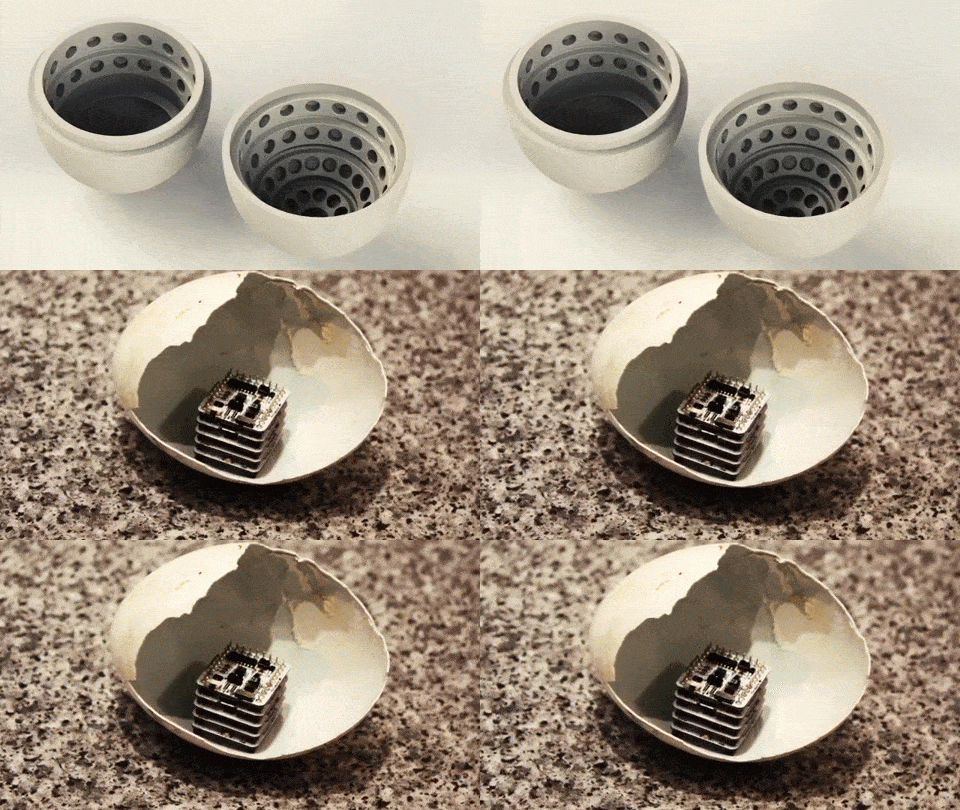
Sensor-Packed Fake Eggs Are Helping Revive Endangered Vulture Populations

sensor eggs vulture

What it is: UK conservationists are using sensor technology to help researchers learn more about endangered species. The EggDuino is a 3D printed egg that looks and feels exactly like a vulture egg, but it's packed with sensors that measure movement, humidity and temperature -- valuable information to understand vultures' natural incubation behaviors and processes.

Why it's important: By understanding how endangered animals naturally reproduce and incubate their young (without disturbing their natural habitat), conservationists can replicate these natural processes in captive breeding environments. Combined with complementary emerging technologies like synthetic biology, and conservationists have a powerful toolchest that could help us slow down or even eradicate extinction.

Spotted by Marissa Brassfield

Artificial Skin That Can Grow Hair and Sweat

lab skin grows hair sweats

What it is: We've seen lab-grown skin grafts and even 3D printed skin, but scientists at the RIKEN Center for Developmental Biology in Japan have created lab-grown skin that can sweat and even grow hair. Unlike today's lab-created skin, which has just one or two layers, RIKEN has the typical three layers of tissue found in human skin, which is why it can hold hair follicles and sweat glands.

Why it's important: One step closer to truly lifelike artificial skin -- which will revolutionize how we treat burn victims and those with skin diseases.

Spotted by Marissa Brassfield

Africa Internet Group is the Country's First Unicorn

africa internet group unicorn

What it is: Africa has its first billion-dollar company: Africa Internet Group. Founded in 2012, AIG operates 71 companies in 26 industries -- all of them focused on bringing Africa online and into the 21st century. Most recently, AIG landed an $85 million investment from French mobile company Orange, which will no doubt help AIG increase its influence in Africa's mobile space.

Why it's important: We've heard Peter say that the best way to become a billionaire is to help a billion people. AIG is doing exactly this in Africa, and we're excited to see what happens as millions of its clients/consumers begin participating in the global economy.

Spotted by Marissa Brassfield

If Google Built a Tech-Filled City From Scratch, Would You Move There?

google tech city

What it is: Dan Doctoroff, CEO of Alphabet subsidiary company Sidewalk Labs, recently made a comment at The Information Summit in New York that piqued journalists' interest. When asked about a rumored technology city test bed, Doctoroff coyly replied that it "would be a great idea," and that "thinking about a city from the internet up is really compelling…[but] cities are hard. You have people with vested interest, political, physical space…But the technology ultimately cannot be stopped."

Why it's important: Technology is changing how we do just about everything. Why not city planning? If we were able to run Google-like experiment sprints on social programs, recreation, transportation, employment, education and environmental issues, we'd gather priceless data -- and possibly world-changing insights.

Spotted by Marissa Brassfield

New Implantable Device Alleviates Pain by Tricking Your Brain With Electrical Pulses

electrical pulses pain            management

What it is: Researchers from the University of Texas at Arlington have developed a pain management solution that involves electrical stimulation of the brain. Unlike similar technology available today (for example, transcutaneous electrical nerve stimulation), this UTA device works at the spinal cord level to block pain signals before they reach the brain.

Why it's important: This pain management technology doesn't have the dangerous side effects of prescription painkillers, like risk of addiction. UTA's studies have shown that this brain stimulation not only blocks pain, it also triggers dopamine release, making it a viable solution to alleviate chronic pain.

Spotted by Marissa Brassfield

OLO: The First Ever Smartphone 3D Printer

olo smartphone 3d printer

What it is: We've seen how a variety of physical devices have been dematerialized into smartphone apps, and OLO's new Kickstarter campaign indicates 3D printers might be next. This $99 device enables users to print 3D objects from their smartphones; according to the OLO campaign page, an iPhone 6 can print 1 inch of material in just under 2 hours.

Why it's important: Think there isn't a market for inexpensive consumer 3D printers? Think again: OLO has raised over $2 million thus far, with 12 days left in their campaign. By dematerializing and demonetizing the traditional 3D printer, making it available to anyone with a touchscreen smartphone, OLO is poised to catalyze democratization of 3D manufacturing.

Spotted by Jeffrey Krause and Cliff C. des Ligneris

Tiny Autonomous Robots Repair Circuitry Without AI

autonomous nanorobots

What it is: Joint research from the University of California at San Diego and the University of Pittsburgh has yielded an autonomous nanobot that can do its job -- repairing broken circuits -- without guidance from artificial intelligence. The researchers were inspired by nature, and specifically how blood platelets aggregate after you cut yourself to catalyze the healing process.

Why it's important: Autonomous nanobots could be used to intelligently deliver drugs within the body, or for self-healing materials. Imagine cellphones that can repair their own cracked screens!

Spotted by Ian Pitchford

Paul Allen Doubles Down on AI Research in Seattle

Paul Allen ai research

What it is: Paul Allen's Allen Institute for Artificial Intelligence has announced plans to advance its Aristo technology to an eighth-grade level, and is scaling up its team and Seattle office quarters to do so. Aristo is an AI that is training to be a science expert -- a unique challenge, considering they don't have an unlimited number of scientific test questions at their disposal for training purposes.

Why it's important: "Eventually, AI2 wants to have a smart enough system that it can act as an assistant in different fields of science," reports the Seattle Times. "For example, it could scan hundreds of thousands of medical-journal articles in an instant to give doctors immediate answers to their questions." Eventually, Aristo could potentially create its own hypotheses.

Spotted by Sarah Black

What is Abundance Insider?

This email is a briefing of the week's most compelling, abundance-enabling tech developments, curated by Marissa Brassfield in preparation for Abundance 360. Read more about A360 below.

Want more conversations like this?

At Abundance 360, Peter's 250-person executive mastermind, we teach the metatrends, implications and unfair advantages for entrepreneurs enabled by breakthroughs like those featured above. The program is highly selective and we're almost full, but we're still looking for a few final CEOs and entrepreneurs who want to change the world. You can apply here.

Know someone who would benefit from getting Abundance Insider? Send them to this link to sign up.


If you wish to stop receiving our emails or change your subscription options, please Manage Your Subscription
PHD Ventures , 800 Corporate Pointe, Suite 350, Culver City, CA 90230


Avast logo

This email has been checked for viruses by Avast antivirus software.
www.avast.com


Sunday, April 3, 2016

Fwd: Key Hiring Lessons from Amazon, Uber, Groupon, etc.


---------- Forwarded message ----------
From: Peter Diamandis <peter@diamandis.com>
Date: Sun, Apr 3, 2016 at 10:01 AM
Subject: Key Hiring Lessons from Amazon, Uber, Groupon, etc.
To: STeve <stevescott@techacq.com>


If you want to create a successful, hyper-growth company you've got to get one thing right – hiring.

To kick off my series of blogs on "Hiring, Culture, and Experimentation", I had a chance to catch up with Jeff Holden, the current Chief Product Officer of Uber.

Jeff is a brilliant entrepreneur and executive who has held leadership roles at three hyper growth companies – Amazon, Groupon, and Uber.

We talked about many things, but in this blog, we'll focus on Jeff's advice for hiring -- these are critical lessons for every entrepreneur, so let's dive in.

Jeff Holden's Rocket Ride…

Jeff spent the first 5 years of his career at D. E. Shaw & Company, a hedge fund in New York.

With a background in computer science, Jeff soon linked up with another Jeff at D.E. Shaw…. Jeff Bezos, that is. Bezos was his first manager at D.E. Shaw, and when Bezos decided to leave the hedge fund to build an Internet company to "sell books," Jeff Holden joined him.

Holden then spent 1997-2006 on the ground floor of Amazon, which now has a market cap of $277 billion.

Holden left Amazon in 2011 to join Groupon, where he spent three years as the SVP of Product Development.

And in 2014, Travis Kalanick (CEO of Uber) tapped Jeff to come lead the product team at Uber.

Over the past 20 years, Holden has learned how to build amazing teams and create powerful cultures around experimentation and solving big problems.

As such, here are few of the key principles Jeff shared around attracting and hiring the best people in the world.

1. A-players Hire A-players and B-players Hire C-players – So Be Ruthless about Hiring A's

In order to hire the best people, you have to be ruthless.

As Jeff Holden explained, "There's literally nothing more important than getting the right people on your rocket ship."

If you lower the bar on the quality of people you let in, they will have a lower bar for the quality of people they hire. The spiral will continue to cascades downward until you're left with, well… a mediocre company.

Jeff has a saying that "A's hire A's and B's hire C's" – I couldn't agree more.

You have to be ruthless about the bar you set.

If you're going to be ruthless, you have to have simple, easy-to-follow mechanisms to make the process work.

Jeff shared some of his experiences creating these mechanisms in very high-pressure, high-growth environments, where hiring managers were ordered to build their teams and not to "dilute themselves into mediocrity."

Here's the story he shared:

"We had to make sure that we kept the bar high, so we created a program called Bar Raisers. It was very powerful and the idea was pretty simple."

"First, we handpicked a small group of people who we knew were ruthless hirers with very high standards. We dubbed them 'Bar Raisers' and their role in the interview process was pretty simple: (i) There always had to be one Bar Raiser in every single interview; and (ii) the Bar Raiser has veto power and nobody can override their veto, including the CEO or the hiring manager."

"What ends up happening is that these Bar Raisers become cultural leaders for raising the bar. They become passionate advocates of "The Bar", almost evangelists."

"Then, the Bar Raisers actually run the hiring debriefs where they collect all of the feedback and data from all of the interviews and distribute this data to the decision makers."

"The first thing we did was to take a vote. We did this with our thumbs. You could vote by putting your thumb in one of four positions – Strong Hire, Inclined to Hire, Not Inclined to Hire, Strong No Hire."

You can't choose "Middle".

"Then, there's a discussion that ensued about what do based on the voting pattern that we observed."

Finally Jeff offered, "We made a decision in that room about whether or not we're going to proceed with an offer or not. This rigor is extremely important."

You'll likely make less offers than you would have without these processes, but the quality of people you do bring in and keep will drive extraordinary value into your business.

2. Always Gauge the Passion & Interest of a Candidate

It's critical that new hires are passionate about and mission-aligned with the company.

You need to screen for this in the hiring process to ensure that there will be cultural fit amongst new people you bring onto the team.

There is a simple way to do this, as Jeff explains, simply ask them "Why do you want to work for this company?"

"It's unbelievable how many people have a terrible answer to that question," Jeff said, "The generic answer is – 'Well, you guys are doing really well…'."

Find people whose answers fit with your culture and core values (a topic we'll discuss in future blogs) and…

3. Be an Owner, Not a Renter -- Hire Patriots, Not Mercenaries

Jeff has a quote that he referenced – "Wars are won by patriots, not mercenaries" -- This is a really important idea.

In the context of hiring, this means that you need to bring patriots onto your team who aren't in it for the money.

You're looking for team members who are passionate about the mission, folks who behave like owners (of your brand, product, vision, people, mission, etc.), rather than renters who always have one foot out the door.

If the candidate just wants to make a lot of money, and they aren't passionate about the mission, they are going to burn out when things get tough and it's going to cost you. These are mercenaries, and they are bad for sustainable growth.

Note**: Be careful – a lot of mercenaries are really good at "saying the right things" to make it seem like they are value-aligned. You have to run a series of culture fit experiments to see if their actions back up their words.

4. Make sure you're working with people that 'Make You Feel Dumb'

Finally, make sure you are working with bright, intelligent people who are constantly pushing you to learn.

The people you surround yourself with in these often stressful work environments (and especially as a startup entrepreneur) can make or break your experience, and more than that, they can make or break the company.

As mentioned, this was just the tip of the iceberg of my conversation with Jeff. We'll dive further into culture and experimentation next week.

Join Me

This is the sort of conversation we explore at my 250-person executive mastermind group called Abundance 360.

The program is highly selective. If you'd like to be considered, apply here.

Share this with your friends, especially if they are interested in any of the areas outlined above.

This blog is the first in a series I am doing on "Hiring, Culture, and Experimentation". If you have questions or comments about these topics, tweet at me @peterdiamandis and @codyrapp, and we'll incorporate them into our research.

P.S. Every week I send out a "Tech Blog" like this one. If you want to sign up, go to Diamandis.com and sign up for this and Abundance Insider.

P.P.S. My dear friend Dan Sullivan and I have a podcast called Exponential Wisdom. Our conversations focus on the exponential technologies creating abundance, the human-technology collaboration, and entrepreneurship. Head here to listen and subscribe: a360.com/podcast


If you wish to stop receiving our emails or change your subscription options, please Manage Your Subscription
PHD Ventures , 800 Corporate Pointe, Suite 350, Culver City, CA 90230


Friday, April 1, 2016

Fwd: Abundance Insider: April 1 Edition


---------- Forwarded message ----------
From: Peter Diamandis <peter@diamandis.com>
Date: Fri, Apr 1, 2016 at 12:04 PM
Subject: Abundance Insider: April 1 Edition
To: STeve <stevescott@techacq.com>


In this week's Abundance Insider: Virtual 3D teleportation, self-cleaning fabric and automated lip-reading algorithms.

Cheers,
Peter, Marissa, Cody, Maxx, Kelley and Greg

P.S. Send any tips to data@diamandis.com, and send your friends and family to this link to subscribe to Abundance Insider.

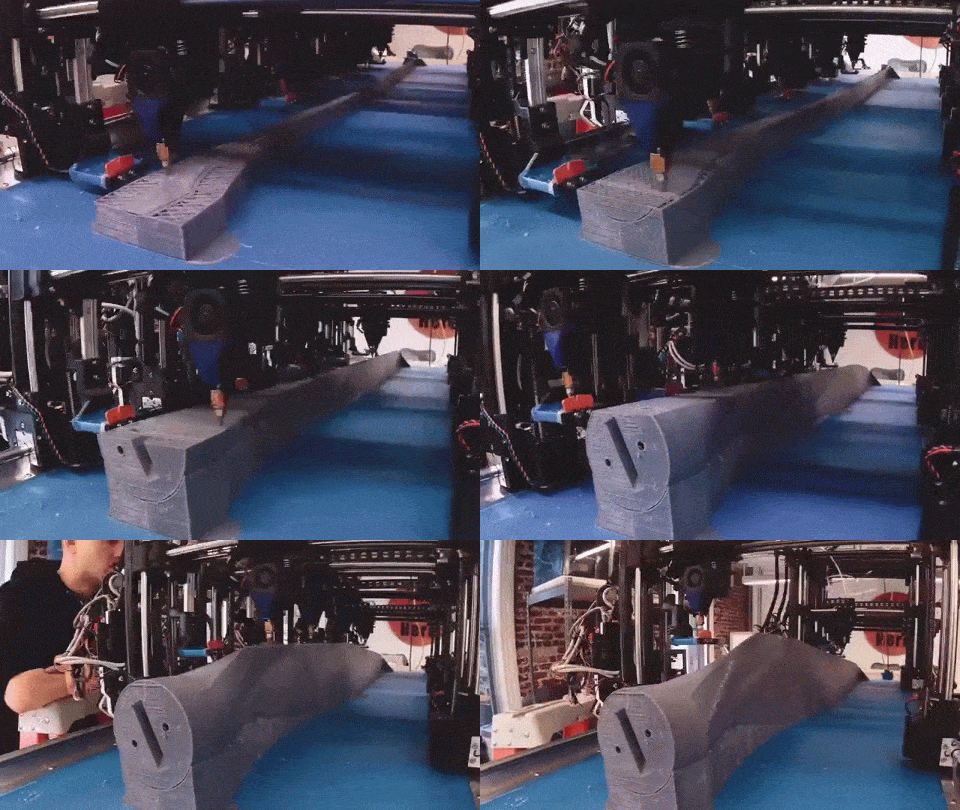
Assembly Line 3D Printers

project escher

What it is: Autodesk's Project Escher enables creators to print large-scale 3D parts with an unprecedented level of detail and speed. Project Escher is essentially a software and control technology that governs a series of 3D printers and coordinates their collaboration, assembly-line-style.

Why it's important: The distributed labor approach Project Escher takes will dramatically accelerate large, complex 3D print projects. In the future, Autodesk believes Project Escher could also incorporate different technologies like laser cutting.

Spotted by Tiago Buhr

Virtual 3D Teleportation in Real Time

holoportation

What it is: A Microsoft Research project called Holoportation is a 3D capture technology that enables users to reconstruct, compress and transmit high-quality 3D models of people anywhere in the world -- in real-time. "When combined with mixed reality displays such as HoloLens, this technology allows users to see, hear, and interact with remote participants in 3D as if they are actually present in the same physical space," explains Microsoft.

Why it's important: When virtual communication feels as seamless and lifelike as face-to-face communication, we'll see a dramatic rise in its adoption -- both in consumer technology and in the enterprise.

Spotted by Sony Mordechai

AI Writes Novel, Passes First Round of Literary Award Screening

artificial intelligence literary competition

What it is: We've seen artificial intelligence systems beat humans at strategy games, but a collaboration between humans and an AI program recently wrote a short-form novel that made it past the first round of screening for the Nikkei Hoshi Shinichi Literary Award. As Futurism reports, this is the first time that the literary award has received AI-generated submissions: "Out of 1,450 entries, 11 were apparently written by non-humans."

Why it's important: Thus far, we've seen AI used most frequently in quantitative situations. But imagine what happens when we enter a phase where, as Futurism describes, "...our greatest works -- works that perfectly capture what it truly means to be human -- may not be written by humans."

Spotted by Aryadeep S. Acharya

Ultrathin Solar Cells: Light Enough to Sit on a Soap Bubble

ultrathin solar cells

What it is: Imagine solar cells so tiny that they can float on top of a soap bubble without popping it. That's exactly what MIT researchers have created: photovoltaic cells as small as 1.3 microns thick (for comparison, LiveScience notes a human hair is about 100 microns thick) and weighing just 3.6 grams per square meter (20 times less than a single sheet of office paper). Best of all, this itty-bitty solar cell performs with the same efficiency as its conventional, glass-based counterparts.

Why it's important: Tiny, efficient and light solar cells are universally valuable. "You could imagine laminating lightweight or even invisible solar cells onto windows or other solid surfaces for building- and device-integrated electronics," said study lead author Joel Jean. "A more robust consumer product might use these cells laminated onto a conventional flexible plastic sheet, which you could carry around with you for portable power."

Spotted by Gabriel Delgado

Study: We Need to Forget New Things to Learn New Things

forget things to learn new things

What it is: Joint research from the European Molecular Biology Laboratory (EMBL) and the University Pablo Olavide has resulted in a new discovery: when we're trying to learn something, our brains actively try to forget something else. "The findings were made using genetically engineered mice, but the scientists demonstrated that it is possible to produce a drug that activates this 'forgetting' route in the brain without the need for genetic engineering," reports KurzweilAI.

Why it's important: This discovery paves the way for PTSD drugs that trigger the brain into forgetting traumatic experiences -- truly personalized therapy.

Spotted by Peter Diamandis

Smart Windshield for Motorcyclists

smart windshield

What it is: The just-annonced Samsung Smart Windshield concept uses a motorcyclist's smartphone, an app and a tiny projector to transform the windshield into a real-time dashboard. A rider can see navigation information and send automated responses to emails, text messages and phone calls -- all without interfering with the rider's vision like a helmet display might.

Why it's important: Samsung's augmented reality concept indicates how the brand is experimenting with virtual worlds -- and how motorcycles of the future might adopt the autonomous driving features we're now seeing in passenger cars.

Spotted by Kim Butler

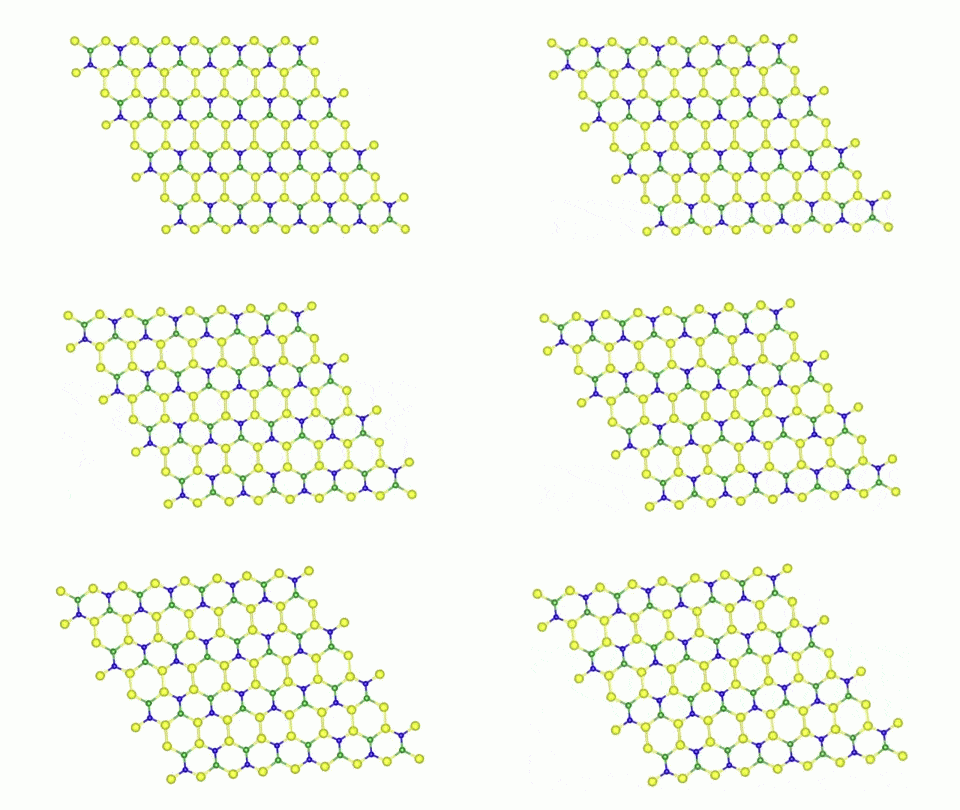
New 2D Material Could Upstage Graphene

2d material Si2BN

What it is: We've covered graphene extensively in Abundance Insider, but a new 2D material called Si2BN could be the next big breakthrough in this field. Made up of silicon, boron and nitrogen, the material is just an atom thick. Unlike graphene, Si2BN can function either as a conductor or semiconductor.

Why it's important: Si2BN has promising implications for solar energy conversion and electronics applications due to its stable, lightweight, inexpensive and earth-abundant elements.

Spotted by Peter Diamandis

Automated Lip-Reading Invented

automated lip reading

What it is: The University of East Anglia has developed a visual speech recognition technology that can differentiate between similar-appearing sounds like '/p/,' '/b/,' and '/m/'. "Lip-reading is one of the most challenging problems in artificial intelligence, so it's great to make progress on one of the trickier aspects, which is how to train machines to recognize the appearance and shape of human lips," said co-creator Richard Harvey.

Why it's important: We've all experienced or observed scenarios in which subpar audio negatively affected our ability to communicate -- think noisy cars, airplane cockpits, or conversations with people who have hearing and speech impediments. A lip-reading algorithm could revolutionize all of these scenarios, and help law enforcement solve crimes.

Spotted by Peter Diamandis

Self-Cleaning Fabric

self cleaning fabric

What it is: Researchers at the Royal Melbourne Institute of Technology have created a technology that grows metallic nanostructures directly on fabrics. When exposed to light, these copper- and silver-based constructs create "hot electrons" that, as Gizmag explains, "release energy bursts that dissolve organic matter." It takes about 30 minutes for these nanostructures to form after fabric is dipped into solutions; from there, they observed cleaning action in as little as six minutes after a stain.

Why it's important: Imagine clothing and other fine textiles made of fabrics resistant to substances like red wine or tomato sauce. "There's more work to do before we can start throwing out our washing machines," explains RMIT researcher Rajesh Ramanathan, "but this advance lays a strong foundation for the future development of fully self-cleaning textiles."

Spotted by Aryadeep S. Acharya

DARPA's Targeted Neuplasticity Training Program Enables Superhuman Learning

targeted neuroplasticity training

What it is: DARPA's new program, Targeted Neuroplasticity Training, hopes to enable learning "beyond normal levels" via targeted stimulation of the peripheral nervous system. The process involves stimulating specific peripheral nerves through the skin, causing the brain to "release neurochemicals in the brain that reorganize connections in response to specific experiences," according to program manager Doug Weber.

Why it's important: DARPA's goal is to, according to KurzweilAI, "optimize training protocols that expedite the pace of learning and maximize long-term retention of even the most complicated cognitive skills." This would dramatically accelerate the pace of training in fields like cryptography, intelligence and foreign languages.

Spotted by Peter Diamandis

What is Abundance Insider?

This email is a briefing of the week's most compelling, abundance-enabling tech developments, curated by Marissa Brassfield in preparation for Abundance 360. Read more about A360 below.

Want more conversations like this?

At Abundance 360, Peter's 250-person executive mastermind, we teach the metatrends, implications and unfair advantages for entrepreneurs enabled by breakthroughs like those featured above. The program is highly selective and we're almost full, but we're still looking for a few final CEOs and entrepreneurs who want to change the world. You can apply here.

Know someone who would benefit from getting Abundance Insider? Send them to this link to sign up.


If you wish to stop receiving our emails or change your subscription options, please Manage Your Subscription
PHD Ventures , 800 Corporate Pointe, Suite 350, Culver City, CA 90230